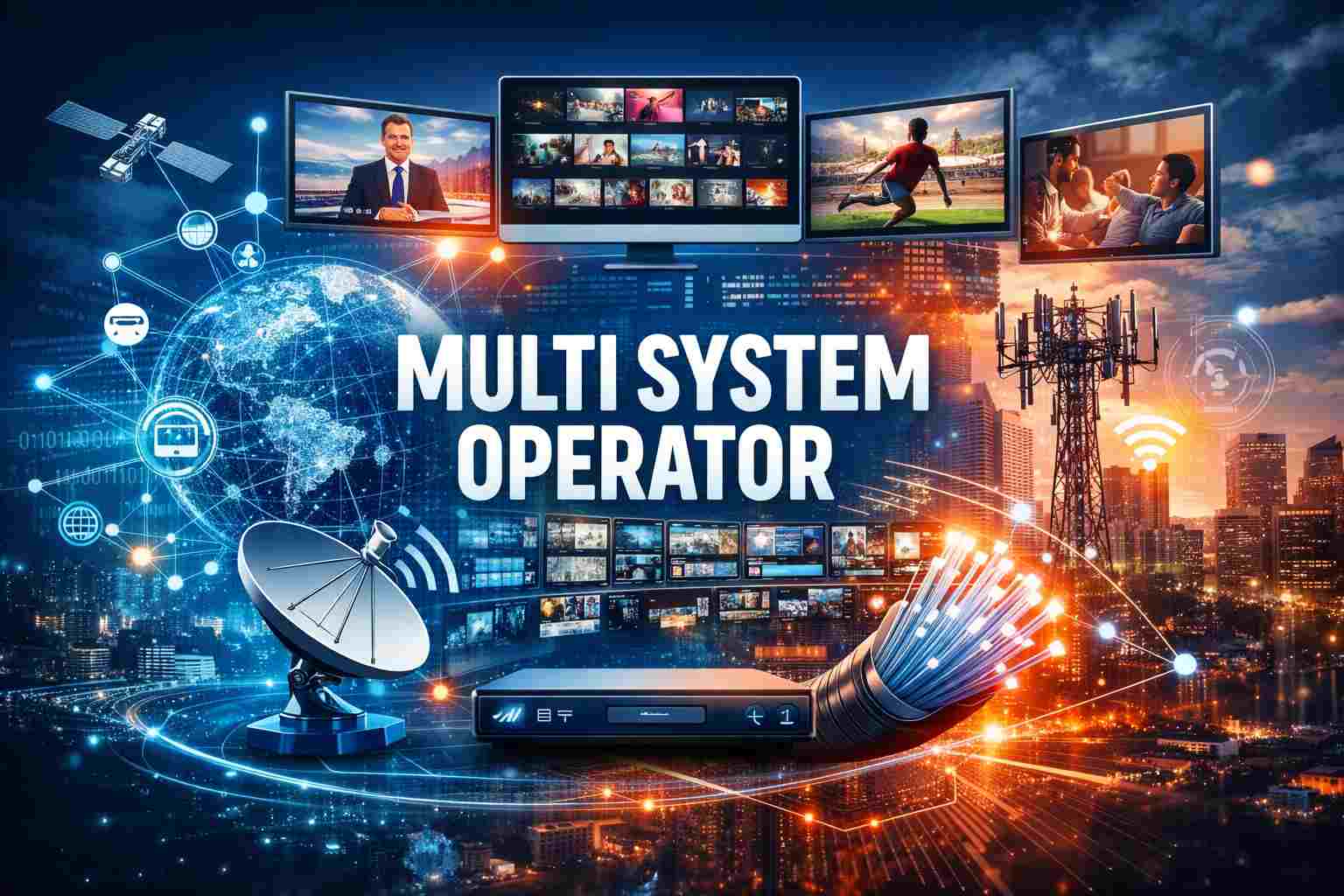
A Multi System Operator (MSO) is an entity that receives television programming from broadcasters and then re‑transmits that content directly to subscribers or through local cable operators (LCOs). MSOs operate multiple cable or broadcast distribution systems simultaneously.
MSOs are licensed under industry regulations (for example, cable television rules in many countries) and must comply with technical and compliance standards set by authorities.
In simple terms, an MSO is a corporate distribution network that connects broadcaster content to many different customer access points across regions, states, or countries.
How Multi System Operators Work
MSOs operate cable television and broadcast distribution systems. They obtain rights to content from television broadcasters and then aggregate that content into a single signal feed. This feed includes many channels and is distributed to households, businesses, and local operators.
Core Functions of an MSO
| Function | Description |
|---|---|
| Content Reception | MSOs receive programming feeds from broadcasters. |
| Signal Aggregation | Multiple channels are merged into a single distribution stream. |
| Transmission | Signals are sent through cable networks to LCOs or directly to consumers. |
| Licensing & Compliance | MSOs secure licenses and maintain regulatory compliance. |
| Technology Deployment | Use of digital headends, encryption, and addressable systems for service delivery. |
MSOs play a critical role in signal encryption, subscriber management, channel packaging, and quality control systems.
Difference Between MSO and Local Cable Operator (LCO)
Understanding the difference between an MSO and an LCO is key to grasping the cable distribution ecosystem.
| Role | Description |
|---|---|
| MSO | Operates multiple broadcast systems; distributes signals to various regions. |
| LCO | Receives MSO signals and delivers them to homes and businesses in specific local areas. |
MSOs work on a larger scale and handle content from broadcasters. LCOs focus on last‑mile delivery to the end consumer.
Technology That Enables MSOs
To deliver content efficiently, MSOs use advanced network technologies like:
Hybrid Fiber‑Coaxial (HFC) Networks
A major MSO technology is Hybrid Fiber‑Coaxial (HFC). This infrastructure combines fiber optics and coaxial cabling to carry video, voice, and internet services.
HFC enables two‑way communication, where signals flow from central headends to subscribers and back for Internet and voice services.
Digital Headends and Encryption
MSOs use digital headend systems that receive broadcast signals, compress them, and encrypt them for secure distribution. These systems control access for subscribers and manage channel packages.
MSO Business Models
MSOs operate on structured business models that generate revenue through:
Subscription Fees
Subscribers pay monthly or annual fees to access channel packages.
Carriage Fees
Broadcasters pay MSOs to carry certain channels on premium packages.
Value‑Added Services
MSOs often provide internet services, voice calls (VoIP), and digital value applications.
Some MSOs partner with telecommunication providers or launch their own services such as over‑the‑top (OTT) content delivery platforms and smart services.
Learn More: Buy TikTok Followers: A Complete, Practical, and Transparent Guide
Examples of Multi System Operators
MSOs operate in numerous regions globally. Here are notable examples:
United States MSOs
| Company | Primary Service Name |
|---|---|
| Charter Communications | Spectrum |
| Comcast | Xfinity |
| Cox Communications | Contour |
| Altice USA | Optimum |
International MSOs
| Company | Region |
|---|---|
| Rogers Communications | Canada |
| Shaw Communications | Canada |
| Virgin Media | United Kingdom |
| Siti Cable | India |
| DEN Network | India |
These operators manage millions of subscribers and provide bundled TV, internet, and telephony services.
Regulatory Environment of MSOs
MSOs are subject to regulatory frameworks that govern licences, content distribution rights, and consumer protection norms.
Licensing Requirements
In many countries, MSOs must obtain a special license or registration to operate. Regulations may require:
-
Technical capability proof
-
Financial compliance
-
Security clearances
-
Professional track record
In India, for example, MSOs are required to register under the Cable Television Networks (Regulation) Act and follow rules for content distribution and reporting.
Enforcement and Compliance
Regulatory authorities may cancel MSO licenses if operators fail to meet compliance standards. In India, the Ministry of Information and Broadcasting (MIB) cancelled many MSO registrations due to statutory lapses, reducing the total count significantly in recent years.
How MSOs Are Evolving
The cable distribution industry is evolving due to technological change and market trends:
Shift Toward Internet Services
MSOs now offer broadband internet, VoIP, and digital solutions beyond traditional TV.
Competition With OTT Platforms
Streaming services (like YouTube TV, Hulu, and others) are competing with MSOs for audience and revenue.
Integration of IoT and Smart Services
Advanced MSOs provide home automation, IoT device support, and integrated smart services for consumers.
Key Differences: MSO vs. Private Cable Operator
| Term | Primary Focus |
|---|---|
| MSO | Operates multiple broadcast networks across regions. |
| Private Cable Operator (PCO) | Small independent operator serving limited areas, buildings, or communities. |
PCOs may offer voice, data, or internet services in addition to cable, but they do not operate large multi‑region networks like MSOs do.
Multi System Operator Market Data (Subscriber Example)
| Rank | Provider | Subscribers | Technology |
|---|---|---|---|
| 1 | Charter Communications | ~14,122,000 | Cable |
| 2 | Comcast | ~14,106,000 | Cable |
| 3 | DirecTV | ~11,300,000 | Satellite/IPTV |
| 4 | Dish Network | ~6,471,000 | Satellite |
This data shows how top MSOs rank based on subscriber numbers and technology types.
Read More: True People Search: Complete Guide to Finding People, Understanding Data, and Protecting Privacy
FAQs About Multi System Operators
Q1. What does MSO stand for?
MSO stands for Multi System Operator, an entity that distributes television programming across multiple systems or regions.
Q2. How does an MSO earn revenue?
MSOs earn revenue through subscriber fees, carriage fees, and value‑added digital and internet services.
Q3. Is an MSO the same as a cable operator?
An MSO is a type of cable operator but specifically operates multiple systems across wide regions, unlike local single‑area operators.
Q4. Can MSOs provide internet services?
Yes, modern MSOs often provide broadband, VoIP, IoT services, and bundled digital solutions.
Conclusion
Multi System Operators are critical pillars in modern cable and broadcast infrastructure. MSOs manage large networks, link broadcasters to consumers, and deliver integrated digital services across regions and markets. Their evolution continues as technology and consumer preferences shift toward high‑speed internet and smart integrated entertainment solutions.
