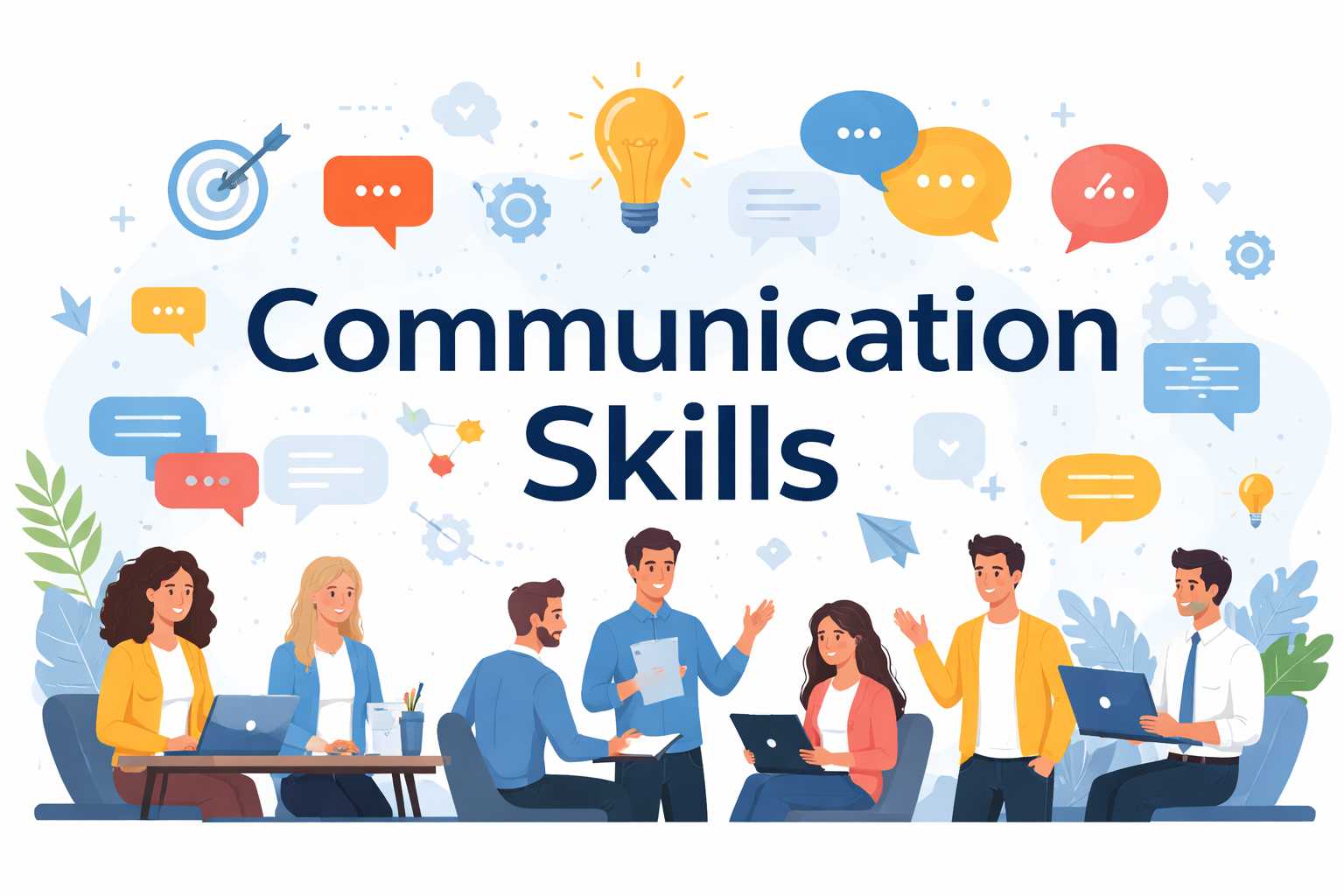
Communication skills refer to the structured abilities used to share information, ideas, emotions, and instructions between individuals or groups. Communication skills support understanding, coordination, decision-making, and relationship management. These skills function across spoken, written, visual, and nonverbal channels. Communication skills operate in workplaces, education systems, digital platforms, leadership roles, and daily interactions. Strong communication skills increase clarity, reduce errors, and improve outcomes.
What Are Communication Skills?
Communication skills are the measurable abilities that allow a person to send, receive, and interpret messages accurately. Communication involves message creation, message delivery, message reception, and message interpretation. Each stage affects the final meaning. Communication skills combine language knowledge, behavioral control, emotional awareness, and contextual understanding.
Communication skills include:
-
Verbal expression
-
Active listening
-
Written clarity
-
Nonverbal signaling
-
Visual presentation
These elements work together to ensure that information remains accurate and useful.
Why Communication Skills Are Important
Communication skills determine how effectively information moves between people and systems. Poor communication increases misunderstandings, delays, and conflict. Strong communication improves productivity, cooperation, and trust.
Key reasons communication skills matter:
-
Communication reduces operational errors
-
Communication improves teamwork and collaboration
-
Communication supports leadership effectiveness
-
Communication strengthens professional relationships
-
Communication improves customer and client satisfaction
Communication skills directly influence career growth, academic success, and organizational performance.
Main Types of Communication Skills
Verbal Communication Skills
Verbal communication skills involve spoken language. These skills include tone control, pronunciation, vocabulary selection, and sentence structure. Verbal communication appears in meetings, phone calls, interviews, discussions, and presentations.
Key elements of verbal communication:
-
Clear speech
-
Appropriate tone
-
Logical flow
-
Purpose-driven messaging
Strong verbal skills help listeners understand intent and direction.
Nonverbal Communication Skills
Nonverbal communication skills involve signals that do not use words. These signals often influence interpretation more than speech. Body posture, facial expressions, eye contact, gestures, and physical distance shape perception.
Common nonverbal elements:
-
Facial expressions
-
Eye contact
-
Body posture
-
Hand gestures
-
Physical spacing
Aligned nonverbal cues increase credibility. Conflicting cues create confusion.
Written Communication Skills
Written communication skills focus on clarity and structure in text-based communication. Writing appears in emails, reports, instructions, proposals, policies, and documentation.
Key written communication features:
-
Clear sentence structure
-
Logical organization
-
Accurate grammar
-
Relevant formatting
Effective writing reduces rework and preserves records.
Visual Communication Skills
Visual communication skills involve conveying information using images, symbols, charts, graphs, diagrams, and layouts. Visual communication improves speed of understanding and memory retention.
Examples of visual communication:
-
Presentation slides
-
Infographics
-
Flowcharts
-
Dashboards
-
Instructional diagrams
Visual elements support complex data explanation.
See More: Understanding 111 Angel Number
Core Communication Skills You Must Understand
Active Listening
Active listening means fully focusing on the speaker and confirming understanding. This skill improves message accuracy and reduces assumptions.
Active listening actions:
-
Maintain attention
-
Ask clarifying questions
-
Summarize key points
-
Avoid interruptions
Listening accuracy strengthens relationships.
Clarity and Precision
Clarity ensures messages are direct and easy to understand. Precision removes unnecessary details and vague language.
Clear communication includes:
-
Defined purpose
-
Simple structure
-
Relevant details
-
Clear outcomes
Clarity saves time and reduces mistakes.
Empathy in Communication
Empathy involves recognizing emotions and perspectives during interaction. Empathetic communication improves trust and cooperation.
Empathy actions:
-
Acknowledge feelings
-
Respect viewpoints
-
Use neutral language
-
Avoid judgment
Empathy stabilizes difficult conversations.
Confidence in Delivery
Confidence appears through controlled tone, steady posture, and decisive language. Confident communication increases credibility and influence.
Confidence indicators:
-
Consistent tone
-
Clear posture
-
Calm pacing
-
Direct wording
Confidence supports leadership presence.
Feedback Skills
Feedback skills involve sharing observations to improve performance or understanding. Effective feedback focuses on facts, not opinions.
Good feedback includes:
-
Specific observations
-
Objective language
-
Clear impact explanation
-
Action-oriented suggestions
Feedback supports growth and learning.
Adaptability
Adaptability means adjusting communication based on audience, culture, and context. Adaptable communication improves comprehension.
Adaptation factors:
-
Language level
-
Communication channel
-
Cultural norms
-
Situation urgency
Adaptability increases effectiveness across environments.
Communication Styles Explained
| Communication Style | Key Characteristics | Impact |
|---|---|---|
| Passive | Avoids expression | Low clarity |
| Aggressive | Dominates interaction | High conflict |
| Passive-aggressive | Indirect resistance | Confusion |
| Assertive | Clear and respectful | Effective outcomes |
Communication Skills in Real-Life Situations
Workplace Communication
Workplace communication involves task coordination, reporting, meetings, and collaboration. Clear communication defines roles, deadlines, and expectations.
Examples:
-
Project instructions
-
Team meetings
-
Performance updates
-
Email communication
Effective workplace communication improves productivity.
Leadership Communication
Leadership communication aligns teams with goals and direction. Leaders use communication to guide, motivate, and manage change.
Leadership communication includes:
-
Vision explanation
-
Decision communication
-
Change announcements
-
Performance feedback
Consistency builds trust.
Conflict Resolution Communication
Conflict communication focuses on resolving disagreements through structured dialogue. This process reduces tension and misunderstanding.
Conflict resolution steps:
-
Listen to all parties
-
Clarify facts
-
Identify common goals
-
Agree on solutions
Structured communication prevents escalation.
Digital Communication
Digital communication occurs through email, messaging apps, and virtual meetings. Written clarity becomes critical in digital settings.
Digital communication best practices:
-
Clear subject lines
-
Concise messages
-
Defined next steps
-
Proper tone
Digital precision prevents misinterpretation.
Common Barriers to Communication
Assumptions
Assumptions occur when information is implied instead of stated. Explicit clarification prevents misunderstanding.
Emotional Interference
Strong emotions affect interpretation. Emotional control improves message accuracy.
Channel Mismatch
Using the wrong communication channel reduces effectiveness. Complex topics require richer channels.
Cultural Differences
Cultural norms influence interpretation. Awareness improves cross-cultural communication.
How to Improve Communication Skills Step by Step
Improve Listening
To improve listening, remove distractions and confirm understanding through summaries.
Improve Speaking
To improve speaking, structure messages with a clear beginning, middle, and end.
Improve Writing
To improve writing, organize content logically and remove unnecessary words.
Improve Nonverbal Signals
To improve nonverbal signals, align body language with spoken messages.
Improve Feedback
To improve feedback, focus on observable behavior and measurable impact.
Communication Skills for Career Growth
Communication skills appear in resumes, interviews, and performance evaluations. Employers value candidates who explain ideas clearly, collaborate effectively, and resolve conflict professionally.
Common resume communication skills:
-
Written communication
-
Presentation skills
-
Team collaboration
-
Client communication
-
Conflict management
Evidence strengthens credibility.
Communication Skills and Outcomes
| Skill | Primary Outcome |
|---|---|
| Active listening | Accuracy |
| Clear writing | Efficiency |
| Empathy | Trust |
| Confidence | Credibility |
| Adaptability | Understanding |
| Feedback | Improvement |
Frequently Asked Questions (FAQs)
What are communication skills in simple terms?
Communication skills are the abilities used to share and understand information clearly.
What are the most important communication skills?
The most important communication skills include listening, clarity, empathy, confidence, and adaptability.
How do communication skills help in daily life?
Communication skills reduce misunderstandings and improve relationships.
Are communication skills learned or natural?
Communication skills are learned and improved through practice.
What are examples of communication skills for a resume?
Examples include written communication, presentation skills, and teamwork.
How long does it take to improve communication skills?
Improvement depends on practice frequency and feedback quality.
Do communication skills affect leadership?
Communication skills directly influence leadership effectiveness and trust.
Conclusion
Communication skills represent structured abilities that control how information is exchanged. These skills include verbal, nonverbal, written, and visual communication. Core attributes such as listening, clarity, empathy, confidence, feedback, and adaptability determine effectiveness. Communication styles influence interaction outcomes. Practical application spans workplace, leadership, digital, and conflict contexts. Strong communication skills improve accuracy, efficiency, and professional success.
