
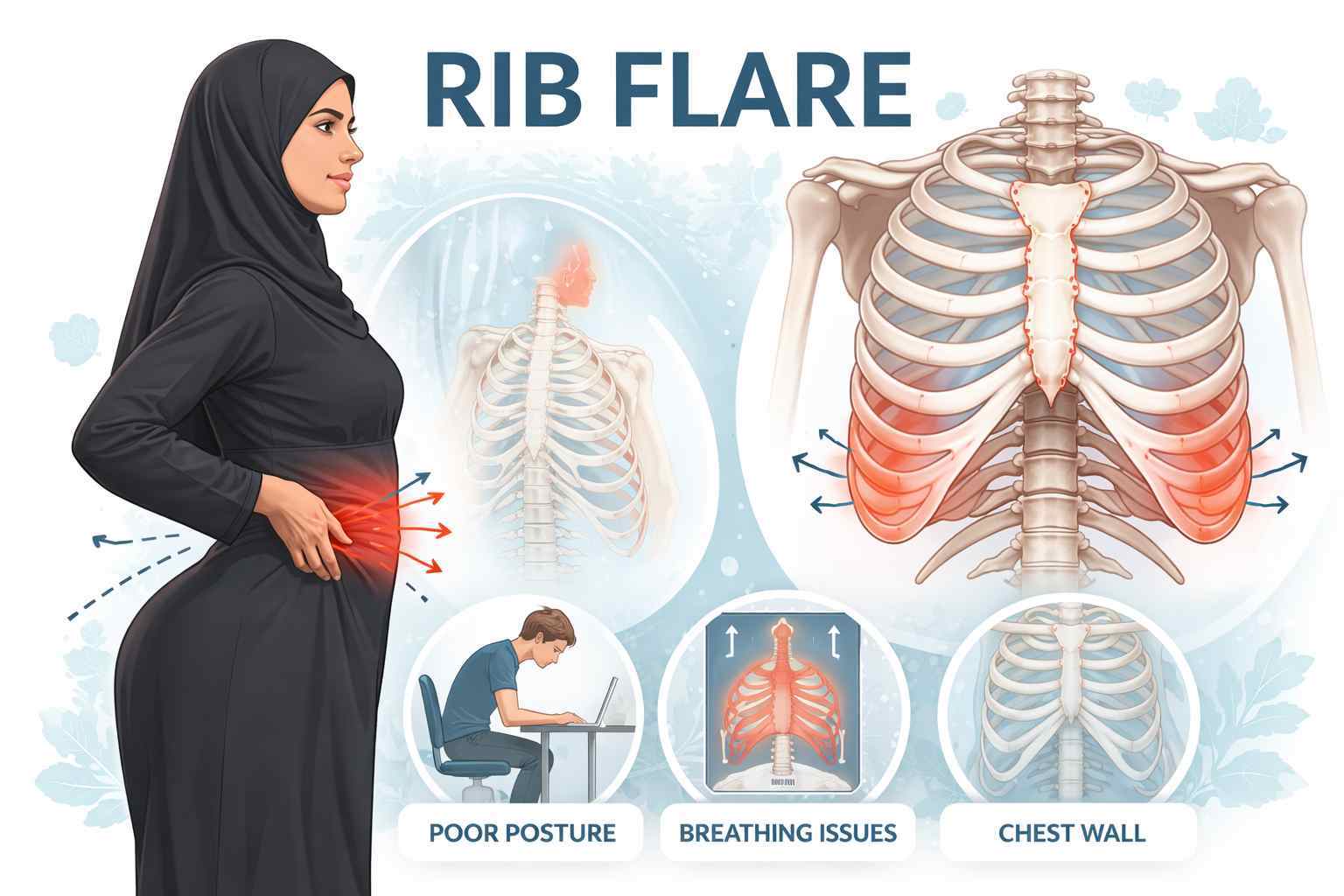
Rib flare is a visible forward angle of the lower ribs relative to the pelvis. Rib flare appears when the costal margin projects outward. Rib flare changes trunk shape and breathing mechanics. Rib flare relates to rib cage orientation and pelvic position. Rib flare presents as symmetrical or one-sided prominence. Rib flare occurs in postural patterns and structural chest wall variation.
Understanding Rib Flare in Simple Terms
Rib flare means the lower ribs point forward more than expected. The costal margin forms the visible edge of the rib cage. The rib cage protects the heart and lungs. The pelvis supports the trunk. The rib cage sits above the pelvis. Rib flare describes a change in this relationship. Rib flare alters how the trunk holds load and how air moves during breathing.
Key anatomical entities linked to rib flare
-
Costal margin: inferior edge of the rib cage.
-
Rib cage: ribs, sternum, thoracic vertebrae.
-
Pelvis: bony ring of the hips.
-
Diaphragm: primary breathing muscle.
-
Thoracic spine: upper and mid-back vertebrae.
-
Abdominal wall: muscles that manage trunk pressure.
Why Rib Flare Happens
Rib flare forms from changes in posture, breathing control, movement patterns, and chest wall structure. Rib flare does not represent a single cause. Rib flare reflects multiple contributors that act together.
Posture and alignment factors
Rib flare increases with chest elevation and trunk extension bias. Rib flare appears when the rib cage tilts forward relative to the pelvis. Rib flare increases with reduced rib cage–pelvis stacking. Rib flare presents with visible sternum elevation in some people.
Breathing pattern factors
Rib flare increases with reduced rib descent during exhalation. Rib flare appears with limited posterior rib expansion. Rib flare relates to dominant upper chest breathing. Rib flare correlates with reduced diaphragm excursion.
Movement and mobility factors
Rib flare associates with reduced thoracic spine mobility. Rib flare correlates with hip extension restriction. Rib flare links to shoulder girdle retraction patterns that elevate the chest. Rib flare reflects kinetic chain compensation.
Structural chest wall factors
Rib flare associates with chest wall morphology variants. Rib flare appears with pectus excavatum and pectus carinatum in some individuals. Rib flare presents as unilateral prominence in asymmetric rib development. Rib flare persists in some structural presentations despite posture change.
Who Commonly Shows Rib Flare
Rib flare appears across age groups and activity levels. Rib flare appears in adolescents with chest wall variation. Rib flare appears in athletes with extension-biased training patterns. Rib flare appears in postpartum populations with altered trunk pressure control. Rib flare appears in sedentary workers with prolonged seated posture.
Signs and Practical Effects of Rib Flare
Rib flare shows visible prominence of the lower ribs. Rib flare alters trunk contour. Rib flare changes breathing mechanics. Rib flare changes trunk stability during tasks. Rib flare presents as asymmetry in unilateral cases. Rib flare may coexist with back discomfort in extension-biased posture. Rib flare often raises cosmetic concern.
Read Also: How Long Does Adderall Stay in Your System? (Complete, Evidence-Based Guide)
How to Check Rib Flare at Home
To check visual alignment
Observe lower rib prominence in relaxed standing. Observe left–right symmetry at the costal margin. Observe rib cage position relative to pelvic landmarks.
To check breathing mechanics
Observe rib motion during slow exhalation. Observe whether ribs move downward and inward. Observe chest rise versus belly expansion during inhalation.
To check posture relationship
Observe rib cage position over pelvis in side view. Observe sternum height relative to abdominal wall contour.
Evidence-Based Care Pathways for Rib Flare
Rib flare management focuses on respiratory control, trunk stability, and movement integration. Rib flare responds to conservative care in flexible presentations. Rib flare requires specialist evaluation in structural chest wall variation.
Breathing control strategies
- Train prolonged exhalation to facilitate rib depression.
- Train posterior rib expansion to improve rib cage mobility.
- Reduce accessory muscle dominance during inhalation.
- Coordinate diaphragm motion with abdominal wall tension.
Trunk control strategies
- Activate anterior abdominal wall to stabilize rib orientation.
- Progress anti-extension trunk control with low-load tasks.
- Integrate rib control into upright posture and daily movement.
Movement integration strategies
- Address thoracic spine mobility to normalize rib motion.
- Address hip extension mobility to reduce trunk compensation.
- Coordinate shoulder girdle position with rib cage orientation.
Specialist pathways for structural cases
- Evaluate chest wall morphology in pectus presentations.
- Document rib prominence progression across growth phases.
- Consider orthotic consultation in flexible chest wall presentations.
- Refer to thoracic specialists for complex deformity evaluation.
Rib Flare Causes, Indicators, and Care Focus
| Category | Primary Indicator | Related Entities | Care Focus |
|---|---|---|---|
| Posture alignment | Elevated sternum, rib cage tilt | Rib cage, pelvis, thoracic spine | Stacking control, posture training |
| Breathing mechanics | Limited rib descent on exhalation | Diaphragm, intercostals | Exhalation training, rib mobility |
| Mobility limitations | Reduced thoracic or hip motion | Thoracic spine, hips | Mobility restoration |
| Structural chest wall | Persistent costal margin prominence | Ribs, sternum | Specialist assessment |
| Kinetic chain compensation | Shoulder retraction with chest elevation | Scapulae, thorax | Movement coordination |
Stepwise Plan to Address Rib Flare
Step 1: Restore respiratory control
Train slow nasal inhalation with full exhalation.
Focus rib descent at the end of exhalation.
Expand posterior ribs during inhalation.
Step 2: Restore trunk stability
Engage abdominal wall during low-load tasks.
Maintain rib cage–pelvis stacking during movement.
Stabilize trunk during limb motion.
Step 3: Integrate posture into daily tasks
- Align rib cage over pelvis in standing.
- Maintain neutral thoracic position during sitting.
- Coordinate breathing during lifting and reaching.
What Rib Flare Is Not
- Rib flare does not equal isolated rib deformity in all cases.
- Rib flare does not reflect isolated abdominal weakness.
- Rib flare does not resolve with cosmetic focus alone.
- Rib flare does not present the same mechanism in every person.
Practical Prevention Factors
- Maintain rib cage–pelvis stacking during daily posture.
- Maintain full exhalation cycles during breathing practice.
- Maintain thoracic mobility through regular movement.
- Maintain balanced training loads across trunk and hips.
Learn More: What It Means to “Kill Tooth Pain Nerve in 3 Seconds Permanently”
Common Patterns Seen With Rib Flare
Postural patterns
-
Elevated sternum
-
Increased thoracolumbar extension
-
Reduced abdominal wall tension
Breathing patterns
-
Upper chest dominance
-
Limited rib descent on exhalation
-
Reduced posterior rib expansion
Movement patterns
-
Limited thoracic rotation
-
Restricted hip extension
-
Shoulder retraction bias
Rib Flare in Sport and Daily Function
Rib flare changes trunk pressure control. Rib flare alters force transfer between upper and lower body. Rib flare affects overhead reach mechanics. Rib flare affects lifting mechanics. Rib flare changes breathing efficiency during exertion. Rib flare alters trunk stability in running and rotational tasks.
Rib Flare and Growth Phases
Rib flare appears during growth spurts in adolescence. Rib flare reflects rib cage shape changes during skeletal development. Rib flare may change with growth-related posture adaptation. Rib flare requires monitoring during growth to document progression.
Quality Measures for Progress Tracking
- Track rib descent during exhalation.
- Track rib cage–pelvis alignment in side view.
- Track symmetry at the costal margin.
- Track trunk control during low-load tasks.
- Track breathing pattern consistency.
FAQs About Rib Flare
What is rib flare in simple terms?
Rib flare means the lower ribs angle forward relative to the pelvis.
Does rib flare relate to breathing?
Rib flare relates to diaphragm motion and rib cage movement during breathing.
Does rib flare always indicate a chest deformity?
Rib flare appears in postural patterns and structural chest wall variation.
Can rib flare present on one side only?
Rib flare presents as unilateral prominence in asymmetric rib development.
Does rib flare affect movement?
Rib flare alters trunk stability and breathing during movement.
How can rib flare be checked at home?
Rib flare can be observed by viewing lower rib prominence and rib motion during exhalation.
Which professionals assess rib flare?
Rib flare assessment occurs in physiotherapy, orthopedics, and thoracic specialties.
Does rib flare change during growth?
Rib flare changes during adolescence with skeletal development.
Does rib flare relate to posture habits?
Rib flare relates to rib cage–pelvis alignment in daily posture.
Does rib flare require surgery?
Rib flare requires surgical evaluation only in selected structural chest wall presentations.
Conclusion
- Rib flare describes forward projection of the costal margin.
- Rib flare reflects rib cage orientation relative to the pelvis.
- Rib flare arises from posture, breathing, mobility, and structure.
- Rib flare assessment includes visual alignment and breathing mechanics.
- Rib flare care focuses on respiratory control, trunk stability, and movement integration.
