
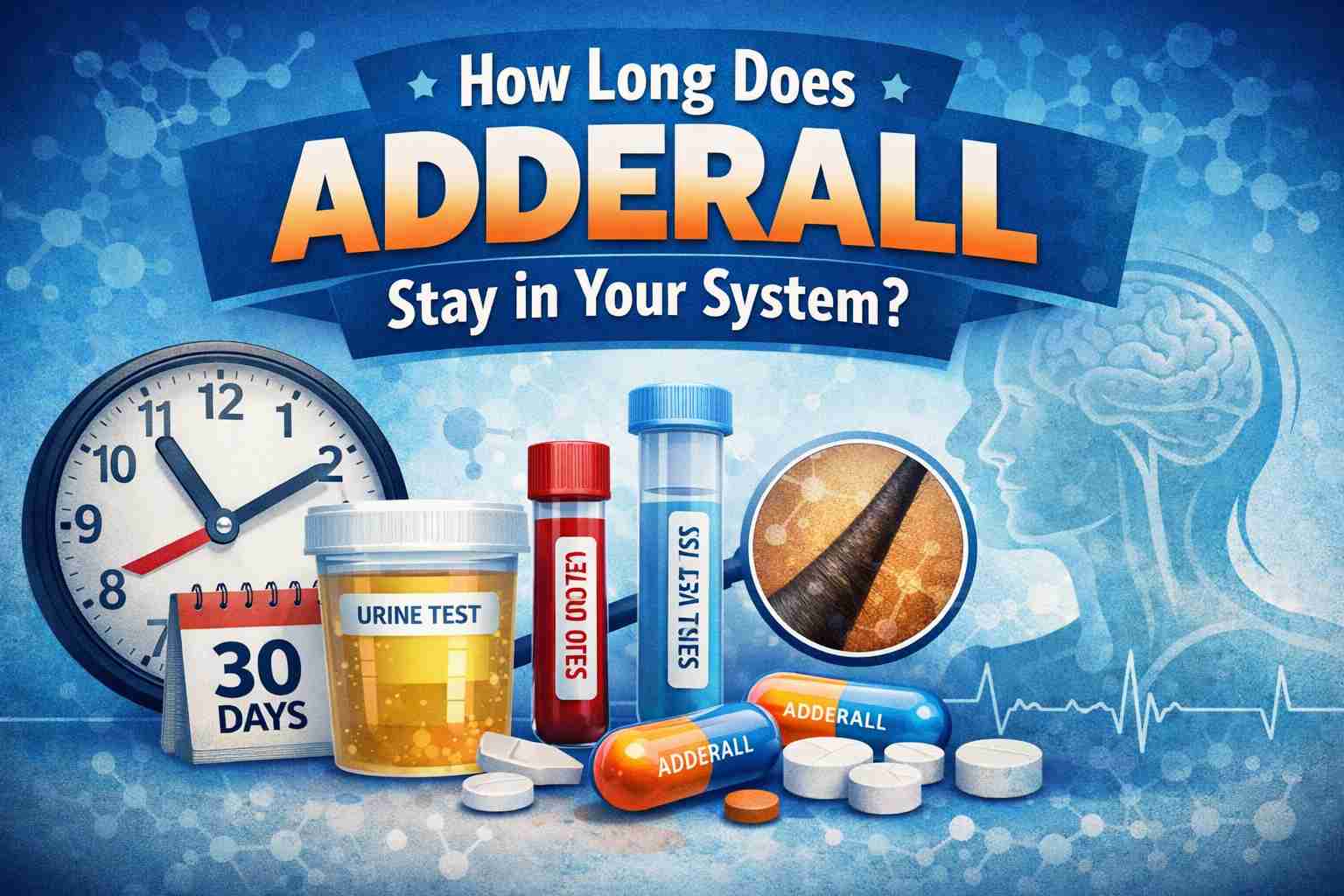
Adderall stays in your system for several days after the last dose. Most healthy adults clear measurable amphetamine from urine within 1 to 4 days. Blood and saliva usually show shorter windows of 1 to 2 days. Hair testing can show past exposure for up to 90 days. These ranges change based on dose, formulation, kidney function, urine acidity, age, and how often the medicine is taken.
What Adderall Is and How the Body Handles It
Adderall is a prescription stimulant made of mixed amphetamine salts. Clinicians prescribe it for attention-deficit/hyperactivity disorder (ADHD) and narcolepsy. After swallowing a dose, the digestive tract absorbs amphetamine into the bloodstream. The liver transforms a portion into metabolites. The kidneys remove most of the drug and its metabolites in urine. Renal excretion is the main exit route.
Key pharmacology facts
-
Amphetamine has oral bioavailability.
-
Peak blood levels appear within hours of dosing.
-
The elimination half-life in adults often falls near 9–14 hours.
-
Renal clearance drives how fast the drug leaves the body.
Authority note: FDA prescribing information and NIH PubChem document these properties.
Detection Time vs. Effect Time (Do Not Confuse Them)
The time Adderall works in the body differs from the time tests can detect it. Clinical effects fade first. Lab detection lasts longer.
Effect duration
-
Immediate-release (IR): about 4–6 hours
-
Extended-release (XR): about 8–12 hours
Detection duration
-
Urine: 1–4 days
-
Blood: up to 24–48 hours
-
Saliva: 1–2 days
-
Hair: up to 90 days
Authority note: FDA labeling covers effect duration by formulation. Forensic toxicology sources define test windows.
Detection Windows by Test Type
| Test Type | What the Test Measures | Typical Detection Window | What Changes the Window |
|---|---|---|---|
| Urine | Amphetamine metabolites | 24–96 hours | Dose, frequency, urine pH, kidney function |
| Blood | Plasma amphetamine | Up to 48 hours | Dose, timing of last dose |
| Saliva | Oral fluid amphetamine | 24–48 hours | Oral contamination, saliva pH |
| Hair | Incorporated drug in hair shaft | Up to 90 days | Hair growth rate, cosmetic treatment |
Authority note: SAMHSA standards guide urine testing. Forensic laboratories publish saliva and hair methods.
Immediate-Release vs. Extended-Release: What Changes
Adderall IR releases the dose at once. Adderall XR releases in two phases. XR extends the time the drug enters the bloodstream. XR does not change how fast the body eliminates amphetamine. XR can extend the detectable window because absorption continues over more hours.
Clear differences
-
IR: faster onset, shorter effect window
-
XR: staggered release, longer exposure window
-
Elimination rate: similar for both
Read Also: Pantagonar: Complete Guide to Benefits, Uses, Ingredients, and FAQs
What Determines How Long Adderall Stays in Your System
Dose and Frequency
Higher doses raise blood concentration. Repeated daily dosing builds steady-state levels. Steady-state exposure extends detection windows after the last dose.
Kidney Function
Kidneys remove amphetamine. Reduced kidney function slows clearance. Slower clearance extends detection windows.
Urine Acidity (pH)
Acidic urine increases amphetamine excretion. Alkaline urine reduces excretion. Diet and some medicines alter urine pH. pH shifts change how long the drug remains measurable.
Age and Body Factors
Children and adults show different clearance rates. Older adults can show reduced renal clearance. Body composition alters volume of distribution.
Drug Interactions
Some medicines change urine pH. Some medicines alter metabolism. Monoamine oxidase inhibitors interact with amphetamines and change safety profiles.
Authority note: FDA labeling and clinical pharmacology references list these modifiers.
Half-Life Explained in Simple Terms
Half-life is the time needed for the blood level to drop by half. After about five half-lives, most of the drug falls below common detection thresholds. With a half-life near 10–14 hours, many adults reach low levels within 2–3 days. Variability remains due to renal function and urine pH.
Authority note: Pharmacokinetic modeling from FDA and NIH sources explains half-life behavior.
Will Adderall Show on a Drug Test?
Yes. Screening tests report “amphetamines.” Confirmatory tests identify specific compounds. A valid prescription explains a positive result. Medical Review Officers verify prescriptions during workplace testing.
Authority note: SAMHSA workplace testing guidelines describe screening and confirmation steps.
Safety and Regulatory Context
Adderall is a Schedule II controlled substance in the United States. Schedule II status reflects accepted medical use and higher misuse risk. The FDA approves Adderall for ADHD and narcolepsy. The label documents cardiovascular and psychiatric risk factors. Monitoring includes blood pressure, heart rate, and symptom review.
Authority note: DEA scheduling and FDA labeling define these standards.
Special Populations
Children and adolescents
Clearance varies by age. Pediatric dosing follows FDA labeling.
Pregnancy and lactation
Amphetamines cross the placenta and appear in breast milk. Clinical references document maternal-fetal transfer.
Kidney disease
Reduced renal function extends detection windows due to slower clearance.
Authority note: FDA labeling and NIH LactMed provide population-specific data.
Practical Takeaways
-
Define detection: urine shows Adderall for 1–4 days in most adults.
-
Separate effects: clinical benefit ends before tests turn negative.
-
Compare forms: XR extends exposure time, not elimination speed.
-
Identify modifiers: dose, frequency, urine pH, kidney health alter clearance.
-
Verify positives: prescriptions explain amphetamine screens.
Common Myths
-
Myth: Drinking water removes Adderall faster.
Fact: Hydration changes urine volume, not elimination rate. Renal clearance and pH drive excretion. -
Myth: XR changes how fast the body clears amphetamine.
Fact: XR changes absorption timing, not elimination kinetics. -
Myth: Effects equal detectability.
Fact: Effects end before laboratory detection ends.
Learn More: What It Means to “Kill Tooth Pain Nerve in 3 Seconds Permanently”
Frequently Asked Questions
How long does a single 10 mg dose stay in urine?
A single low dose often remains detectable in urine for 24–72 hours in healthy adults. Detection varies with urine pH and kidney function.
Authority: FDA labeling and clinical toxicology ranges.
How long after the last XR dose does urine turn negative?
XR can extend the time drug enters blood. Many adults show negative urine results within 2–4 days after the final XR dose.
Authority: FDA formulation data and toxicology references.
Can food change how long Adderall stays detectable?
Food alters absorption timing. Food does not materially change elimination rate.
Authority: FDA pharmacokinetic summaries.
Does body weight change detection time?
Body composition affects distribution. Renal clearance and urine pH dominate elimination time.
Authority: Clinical pharmacology references.
Can a lab tell prescribed use from misuse?
Confirmation identifies amphetamine. Documentation of a prescription explains the result. Pattern analysis may inform clinicians.
Authority: SAMHSA confirmation protocols.
Why does hair testing show use for months?
Hair incorporates drug during growth. Hair reflects historical exposure, not current impairment.
Authority: Forensic hair testing standards.
How long do metabolites stay compared to the parent drug?
Some metabolites persist alongside amphetamine. Urine assays detect both.
Authority: NIH PubChem metabolism data.
Does kidney health change the timeline?
Reduced kidney function slows excretion and extends detection windows.
Authority: NIH renal pharmacology data.
Conclusion
Adderall remains detectable for days after the last dose. Urine testing shows amphetamine for 1–4 days in most adults. Blood and saliva show shorter windows. Hair reflects long-term exposure. Detection differs from effect duration. Formulation alters absorption timing, not elimination speed. Renal clearance, urine pH, dose, frequency, and kidney health determine how long Adderall stays in the system.
Primary authorities: FDA prescribing information; NIH PubChem and LactMed; SAMHSA drug-testing standards; peer-reviewed clinical and forensic toxicology sources.
