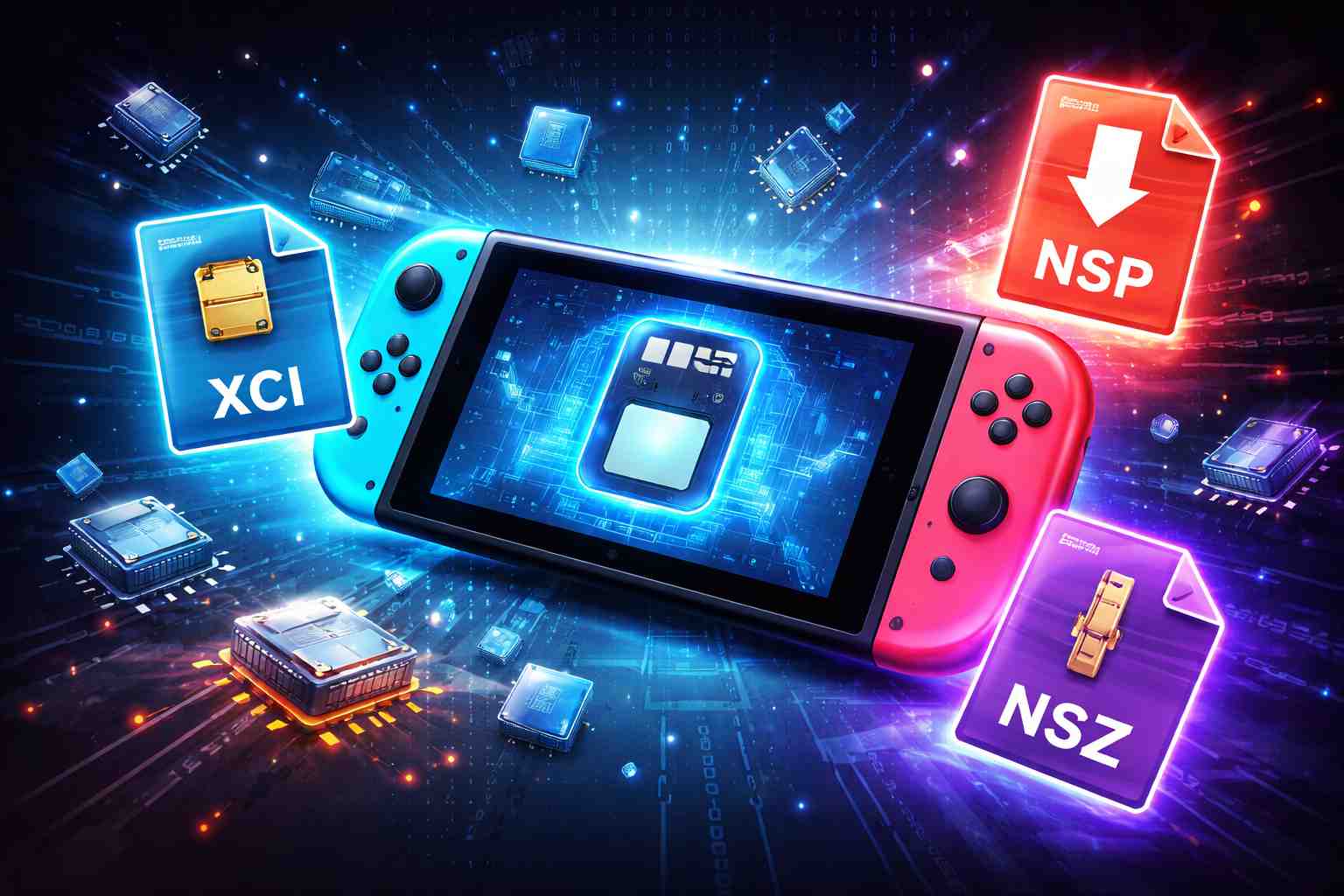
Switch ROMs are digital files that contain Nintendo Switch game data. The term ROM refers to a read-only game image used for storage and archival discussion. In the Nintendo ecosystem, these files mirror how games are packaged for physical cartridges or digital storefront delivery. Official references and technical analyses link these files to the Nintendo Switch, a platform known for cartridge-based and eShop-based distribution.
Switch ROMs appear in conversations about preservation, compatibility research, and software analysis. These discussions focus on file structure and metadata. They do not change copyright ownership or licensing rules.
How Nintendo Switch games are packaged
Nintendo Switch games reach users through two official channels. Each channel maps to a specific file structure.
Physical cartridges
Physical cartridges store encrypted game data on proprietary media. The cartridge contains partitions, certificates, and version information. These elements allow the console to verify authenticity.
Digital downloads
Digital downloads come from the Nintendo eShop. These packages support updates and add-on content. The packaging system allows modular delivery and version control.
Main file formats associated with Switch ROMs
Switch ROMs use standardized formats documented by technical researchers. Each format reflects how the game was distributed.
XCI files
XCI stands for “NX Card Image.”
An XCI file represents a copy of data stored on a physical cartridge. Format documentation explains that XCI files include base game content and cartridge-style partitions. Updates and downloadable content usually remain separate.
NSP files
NSP stands for “Nintendo Submission Package.”
An NSP file represents content delivered through the Nintendo eShop. NSP packages may include the base game, updates, and DLC as separate components. This structure supports incremental updates.
NSZ files
NSZ files are compressed versions of NSP files.
Compression reduces file size without changing the underlying content. NSZ exists to save storage space and bandwidth.
XCI vs NSP: clear differences
The following table summarizes the key distinctions.
| Feature | XCI | NSP |
|---|---|---|
| Distribution source | Physical cartridge | Nintendo eShop |
| Update handling | Separate from file | Integrated via modules |
| Typical size | Fixed | Varies with updates |
| Structure | Cartridge image | Installable package |
Why people search for “Switch ROMs”
Search demand for Switch ROMs exists for several reasons:
-
Preservation research documents long-term access to games.
-
Compatibility analysis studies how software interacts with hardware.
-
Technical learning explores encryption, metadata, and file layout.
These reasons explain interest. They do not remove legal restrictions on copying or sharing copyrighted software.
Legal status of Switch ROMs
The legality of Switch ROMs depends on copyright law. Nintendo holds the copyright to its games. Downloading or sharing copyrighted game files without permission is illegal in many regions.
Enforcement records show that Nintendo actively protects its intellectual property. Ownership of a cartridge or digital license does not automatically grant permission to download copies from third-party sites.
See More: Help Desk Solutions: A Complete, Practical, and Modern Guide
Why Nintendo restricts unauthorized ROM distribution
Nintendo restricts ROM distribution to:
-
Protect copyrighted works.
-
Maintain platform security.
-
Prevent modified software from accessing online services.
Public legal actions confirm these restrictions are enforced through takedown notices and court cases.
Risks linked to unofficial Switch ROM websites
Using unauthorized ROM sources introduces documented risks.
Security risks
Security researchers report that piracy-focused websites often bundle malware with downloads. Threats include spyware, ransomware, and browser hijackers.
Privacy risks
Many ROM sites collect IP addresses and browser fingerprints. Some inject tracking scripts or deceptive ads that harvest user data.
Account and console risks
Nintendo network systems detect irregular software behavior. Accounts and consoles can receive permanent bans from online services.
Hardware stability risks
Modified system files can destabilize firmware. Repair data shows higher failure rates on altered consoles.
Tools mentioned in technical discussions
Some technical discussions reference utilities used for research or backup analysis. One example is NXDumpTool. Documentation describes it as a tool for extracting data from legally owned games for analysis. Mentioning tools explains context. It does not change copyright rules.
Relationship between emulators and Switch ROMs
Emulators simulate console hardware behavior. Projects like Yuzu study Nintendo Switch compatibility.
Key distinction:
-
Emulator software can be legal.
-
Unauthorized game files remain illegal.
This distinction is recognized in multiple legal analyses.
Metadata inside Switch ROM files
Switch ROMs contain structured metadata. This metadata supports system validation and content management.
Common metadata fields include:
-
Title ID
-
Version number
-
Region code
-
Encryption flags
-
Certificate data
Researchers analyze metadata to understand update delivery and compatibility behavior.
Encryption and content protection
Nintendo Switch games use layered encryption. Encryption ties game data to firmware and hardware security modules. This system prevents unauthorized modification and execution. Technical documentation shows encryption as a core component of Nintendo’s platform security.
Legal and safe alternatives to Switch ROM downloads
Several legitimate options exist for accessing Nintendo Switch games.
Digital storefront access
The Nintendo eShop provides licensed downloads, updates, and cloud saves. Purchases link directly to user accounts.
Physical cartridge ownership
Physical cartridges support resale and lending in many regions. This method keeps ownership within legal boundaries.
Subscription services
Nintendo Switch Online offers access to curated retro game libraries under active licenses.
PC and console ports
Some Switch titles receive official ports on other platforms. These releases provide legal access without ROM handling.
Cloud gaming services
Cloud gaming platforms stream licensed gameplay without storing game files locally.
Common misconceptions about Switch ROMs
Many online claims create confusion.
Misconception: Owning a game allows free ROM downloads.
Fact: Copyright law separates ownership from distribution rights.
Misconception: ROM compression makes files legal.
Fact: File format does not affect copyright status.
Misconception: Emulator use removes legal risk.
Fact: Emulator legality does not cover unauthorized content.
Read Also: Help Desk Solutions: A Complete, Practical, and Modern Guide
Best practices for learning about Switch ROMs safely
-
Focus on format documentation and metadata analysis.
-
Use official sources and academic research.
-
Avoid third-party download repositories.
-
Understand copyright boundaries before experimentation.
FAQs about Switch ROMs
What are Switch ROMs used for?
Switch ROMs are discussed in preservation, research, and compatibility analysis contexts. Unauthorized distribution remains illegal.
Are XCI files better than NSP files?
XCI and NSP files serve different distribution models. Neither format is inherently better.
Does compression change legality?
Compression reduces file size only. It does not change ownership or copyright status.
Can a Nintendo account be banned for ROM use?
Yes. Network monitoring systems can issue permanent bans for irregular software behavior.
Is there a legal way to back up Switch games?
Legal backups depend on local law and explicit permissions. Licensed archiving programs operate under agreements with rights holders.
Key takeaways about Switch ROMs
-
Switch ROMs represent Nintendo Switch game data.
-
XCI, NSP, and NSZ reflect cartridge and digital distribution.
-
Unauthorized downloading violates copyright law.
-
Security and account risks are well documented.
-
Legal alternatives provide safe access to games.
Conclusion
Switch ROMs are a technical topic rooted in how Nintendo Switch games are packaged and protected. Understanding formats, metadata, and encryption helps explain why these files exist. Legal boundaries, security risks, and active enforcement shape how the topic should be approached. Licensed purchases, subscriptions, and streaming services remain the safest and most reliable ways to experience Nintendo Switch games.
