
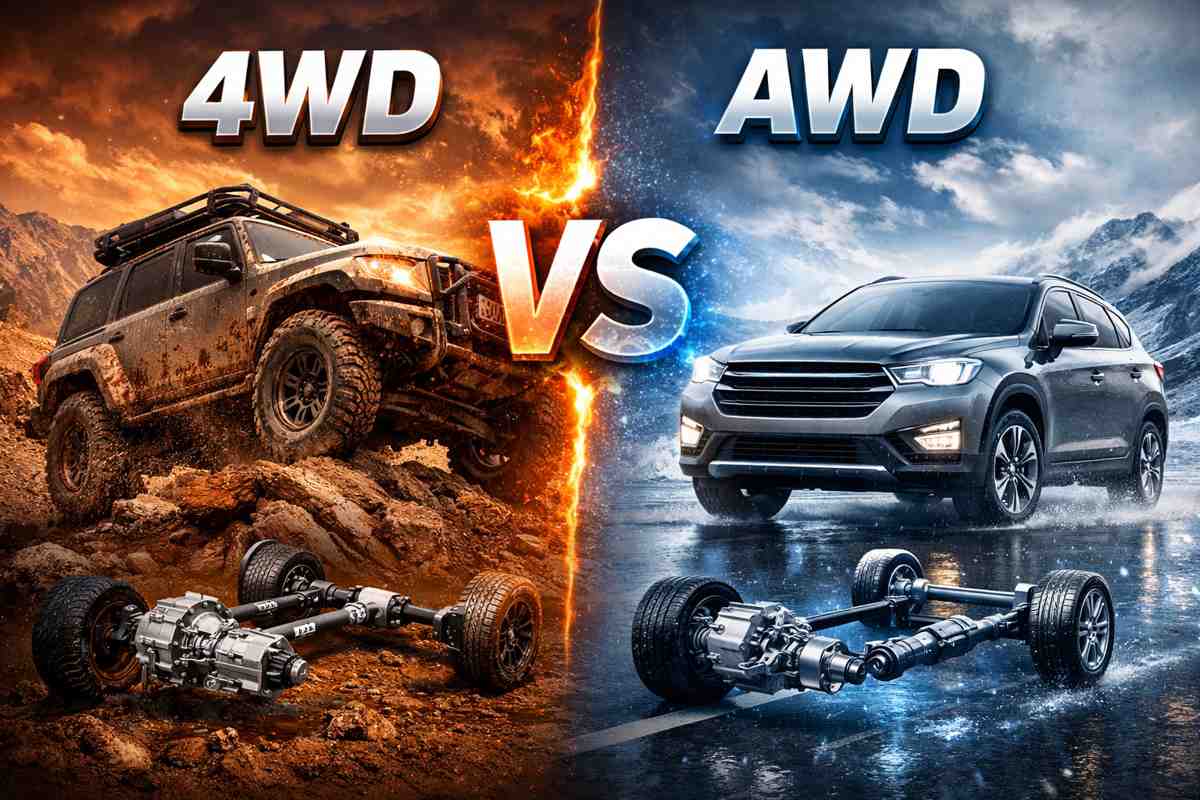
4WD vs AWD explained first: AWD sends power to all four wheels automatically for better road grip in changing weather. 4WD sends power to all four wheels through a selectable system designed for deep mud, rocks, sand, and steep trails. The difference comes from hardware, control method, and terrain purpose.
What 4WD and AWD Actually Mean
What Is AWD?
All-Wheel Drive (AWD) is a drivetrain system that powers both the front and rear axles. Most AWD systems operate full-time. The vehicle’s computer monitors wheel speed, steering input, throttle position, and road conditions. The system adjusts torque between axles without driver action.
AWD is common in crossovers and sedans. Brands like Subaru, Audi, and Toyota use advanced AWD systems in daily-use vehicles.
What Is 4WD?
Four-Wheel Drive (4WD), also called 4×4, uses a transfer case to connect the front and rear axles. Most 4WD systems allow manual selection between:
-
2H (two-wheel drive high range)
-
4H (four-wheel drive high range)
-
4L (four-wheel drive low range)
Low range multiplies torque using reduction gears. This feature is essential for steep climbs and heavy terrain. 4WD is common in trucks and body-on-frame SUVs like the Jeep Wrangler and Ford Motor Company F-150.
How AWD and 4WD Work Internally
AWD Mechanical Design
AWD systems include:
-
Front and rear differentials
-
A center differential or electronic clutch pack
-
Driveshaft connecting axles
-
Wheel speed and stability sensors
Torque distribution varies automatically. Some systems run mostly in front-wheel drive until slip occurs. Others maintain constant torque split such as 50:50.
Many modern AWD vehicles use torque vectoring. Torque vectoring sends different power levels to individual wheels to improve cornering stability.
4WD Mechanical Design
4WD systems include:
-
Transfer case
-
Solid rear axle in many models
-
Manual or electronic shift mechanism
-
Optional locking differentials
When 4H or 4L is engaged, power flows equally to front and rear axles. In low range, gear reduction increases wheel torque while reducing speed. This design supports controlled crawling over obstacles.
Read Also: 9xbuddy Explained: Complete Guide, Uses, Safety, Features, and Smart Alternatives
4WD vs AWD: Side-by-Side Comparison Table
| Feature | AWD | 4WD |
|---|---|---|
| Engagement | Automatic | Driver selectable |
| Low-Range Gear | No | Yes |
| Best For | Rain, snow, highways | Mud, rocks, sand |
| Fuel Efficiency | Better than 4WD | Lower than AWD |
| Drivetrain Weight | Moderate | Heavier |
| Maintenance | Moderate | Higher due to transfer case |
| Common Vehicles | Crossovers, sedans | Trucks, off-road SUVs |
Performance in Different Driving Conditions
Snow and Ice
AWD improves traction in light to moderate snow. The system reacts quickly to slipping wheels. Vehicles such as those from Volvo integrate AWD with stability control for winter driving.
4WD performs better in deep snow. High ground clearance and low range assist when roads are not plowed. However, stopping distance depends on tires, not drivetrain type.
Rain and Wet Roads
AWD improves acceleration on wet pavement. It balances torque during cornering and reduces wheel spin.
4WD offers no major benefit on wet highways when driving normally. Most manufacturers recommend 2H on dry or wet pavement.
Mud, Rocks, and Sand
4WD dominates in serious off-road environments. Low range and locking differentials maintain traction when wheels lift off the ground.
AWD handles light gravel and dirt roads. It struggles in rock crawling due to lack of gear reduction.
Towing and Load Handling
4WD improves traction when launching heavy loads on loose surfaces. Pickup trucks from Chevrolet and Ram Trucks offer 4WD for improved towing grip.
AWD supports light towing tasks. It provides stability but lacks low-range torque multiplication.
Fuel Economy and Weight Differences
AWD adds weight compared to front-wheel drive. The added components reduce fuel efficiency slightly. Many modern AWD systems disconnect rear wheels during steady cruising to save fuel.
4WD adds more weight than AWD. The transfer case and solid axles increase rotating mass. Fuel economy drops more compared to AWD versions of the same vehicle.
Government fuel testing from the United States Environmental Protection Agency confirms that AWD and 4WD models usually show lower MPG than two-wheel-drive models.
Maintenance and Ownership Costs
AWD Maintenance
-
Differential fluid replacement
-
Tire rotation every 5,000–8,000 miles
-
Matching tire sizes required
Uneven tire wear affects AWD calibration.
4WD Maintenance
-
Transfer case fluid changes
-
Inspection of locking hubs
-
Higher wear in off-road use
Repair costs increase when heavy off-road use occurs.
Advantages and Disadvantages
AWD Advantages
-
Automatic traction adjustment
-
Easy daily driving
-
Better fuel economy than 4WD
-
Improved highway stability
AWD Disadvantages
-
No low-range gearing
-
Limited extreme off-road ability
-
Slight fuel economy reduction
4WD Advantages
-
Low-range torque multiplication
-
Superior off-road control
-
Higher durability under stress
-
Better for deep mud and rocks
4WD Disadvantages
-
Heavier system
-
Lower fuel efficiency
-
Requires driver input
-
Higher maintenance complexity
Choosing Between 4WD and AWD
Select AWD when:
-
Driving mostly on paved roads
-
Facing rain or light snow regularly
-
Prioritizing comfort and efficiency
Select 4WD when:
-
Driving off-road frequently
-
Navigating steep, rocky trails
-
Operating in rural or unplowed regions
-
Towing heavy loads on loose ground
Terrain determines system need. Driving pattern defines system value.
See Also: Switch ROMs Explained: Meaning, Formats, Legality, Risks, and Smart Alternatives
Common Myths About 4WD vs AWD
Myth 1: 4WD stops faster in snow.
Stopping depends on tire grip and braking system.
Myth 2: AWD and 4WD are the same.
Hardware and gear systems differ significantly.
Myth 3: AWD is only for snow.
AWD improves stability in rain and dry cornering.
Myth 4: 4WD is always engaged.
Many systems operate in 2H until selected.
Detailed Comparison List for Buyers
Consider these factors:
-
Evaluate terrain frequency.
-
Analyze average road surface.
-
Measure annual snowfall levels.
-
Compare fuel cost impact.
-
Review maintenance schedule.
-
Assess towing requirement.
-
Calculate long-term ownership cost.
Each factor influences drivetrain suitability.
Frequently Asked Questions (FAQs)
1. Is AWD better than 4WD for daily driving?
Yes. AWD provides automatic traction without driver input. It performs efficiently on highways and city roads.
2. Can 4WD be used on dry pavement?
Part-time 4WD should not be used on dry pavement. Driveline binding can occur.
3. Does AWD increase fuel consumption?
Yes. Added drivetrain components increase weight and friction.
4. What is 4L used for?
4L provides low-speed torque multiplication for climbing rocks or deep mud.
5. Is AWD safer than 2WD?
AWD improves traction during acceleration. Braking performance depends on tires and road surface.
6. Which lasts longer, AWD or 4WD?
Durability depends on maintenance and usage. 4WD systems are engineered for heavy terrain use.
7. Do electric vehicles use AWD?
Yes. Many electric vehicles use dual motors to power both axles electronically.
Conclusion
AWD supports everyday traction and weather stability through automatic torque control. 4WD delivers mechanical strength and low-range capability for severe off-road environments. Design, weight, gearing, and terrain purpose create the difference. Road type, climate, towing needs, and fuel efficiency priorities determine the correct system choice.
