
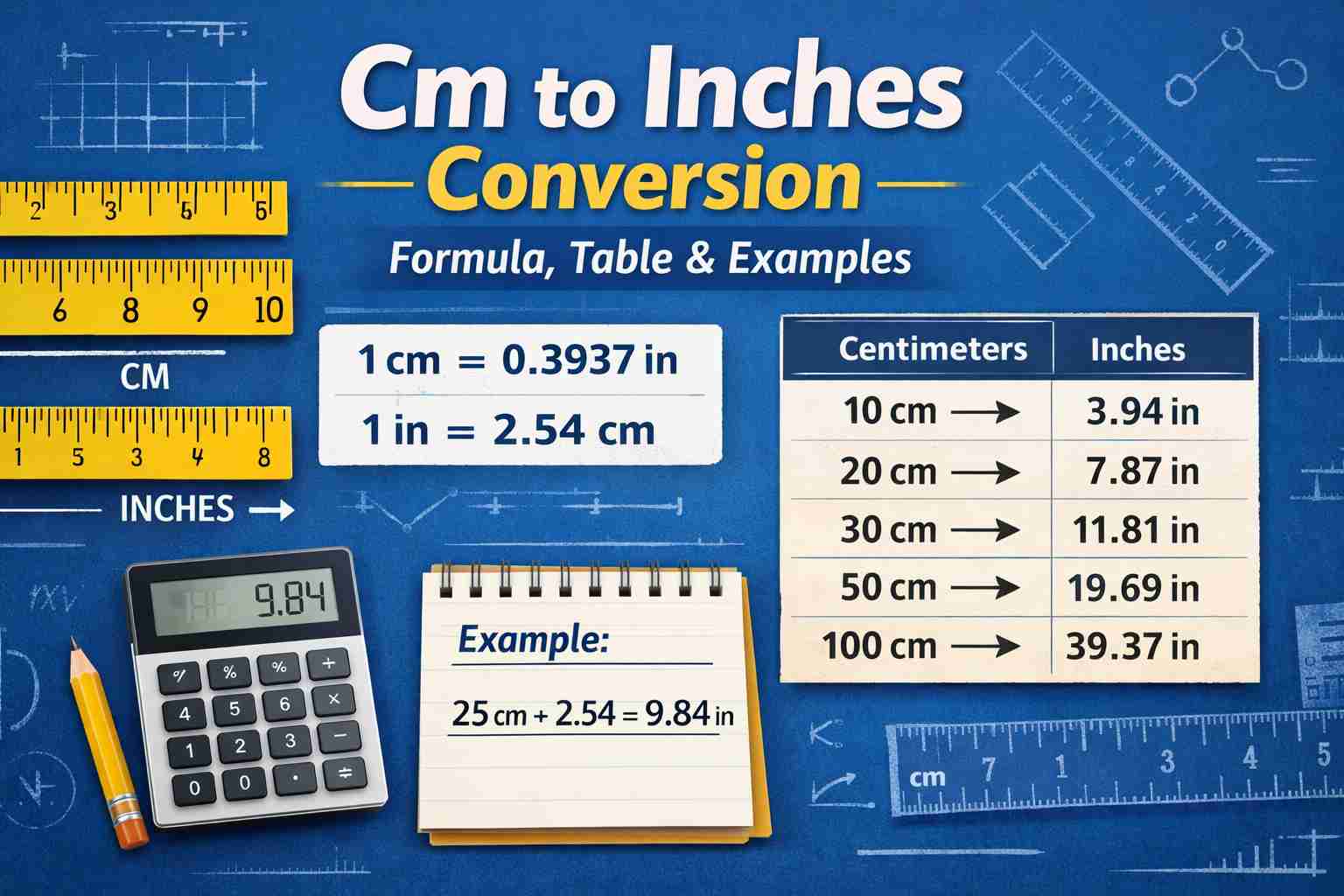
Centimeter to inch conversion explains how a length written in centimeters becomes a length written in inches using a fixed global standard. A centimeter (cm) is a metric unit. An inch (in) is an imperial and U.S. customary unit. Global measurement authorities define the relationship between these units. International System of Units defines the centimeter. National Institute of Standards and Technology aligns inch usage with metric values. The exact rule states that one inch equals exactly 2.54 centimeters. This value never changes.
Why cm to inches conversion exists
Centimeter and inch units developed in different measurement systems. Countries using the metric system rely on centimeters for short lengths. Countries using imperial or U.S. customary systems rely on inches. Cm to inches conversion allows measurements to move between systems without loss of accuracy. Engineering, construction, science, trade, education, and healthcare depend on this conversion for consistency.
Exact conversion value explained
The cm to inches conversion depends on a precise ratio.
-
One inch equals 2.54 centimeters
-
One centimeter equals 0.3937007874 inches
These values come from international agreements, not approximations. Because the base value is exact, all correct conversions start from this relationship.
Cm to inches conversion formula
To convert centimeters into inches, apply one direct calculation.
Inches = centimeters ÷ 2.54
This formula uses the official inch definition. A second valid form exists.
Inches = centimeters × 0.3937007874
Both formulas return the same result. Division is commonly used in education and engineering. Multiplication is common in calculators and digital tools.
How to convert cm to inches step by step
To do cm to inches conversion correctly, follow a simple order.
-
Write the length in centimeters.
-
Divide the number by 2.54.
-
Keep decimal precision until the final step.
-
Round the result based on use.
This process avoids rounding errors and preserves accuracy.
Example conversions with explanation
Examples help confirm the method.
-
Convert 10 cm to inches
10 ÷ 2.54 = 3.937 inches -
Convert 25 cm to inches
25 ÷ 2.54 = 9.8425 inches -
Convert 50 cm to inches
50 ÷ 2.54 = 19.685 inches
Each result comes directly from the same formula.
Cm to inches conversion table (common values)
This table shows frequently used centimeter values converted into inches.
| Centimeters (cm) | Inches (in) |
|---|---|
| 1 | 0.39 |
| 2 | 0.79 |
| 5 | 1.97 |
| 10 | 3.94 |
| 15 | 5.91 |
| 20 | 7.87 |
| 25 | 9.84 |
| 30 | 11.81 |
| 40 | 15.75 |
| 50 | 19.69 |
| 75 | 29.53 |
| 100 | 39.37 |
Values are rounded to two decimals for readability. Exact calculations use the full factor.
Rounding rules in cm to inches conversion
Rounding depends on purpose.
-
Education uses two decimal places.
-
Engineering uses three or four decimals.
-
Construction drawings often use fractions.
-
Medical records keep consistent decimal precision.
Rounding always happens after conversion, not during calculation.
Converting decimal inches to fractions
Some industries prefer fractional inches.
-
0.25 inches equals 1/4 inch
-
0.50 inches equals 1/2 inch
-
0.75 inches equals 3/4 inch
To convert decimals to fractions, match the decimal value to the nearest standard fraction. This method appears in carpentry, machining, and drafting.
Cm to inches in daily measurements
Many objects use centimeters in manufacturing and inches in display.
-
Furniture dimensions convert for international catalogs.
-
Screen sizes convert for marketing standards.
-
Tools show both units on rulers and tapes.
Dual-unit markings rely on the same conversion factor.
Height conversion from cm to inches
Human height often appears in centimeters in medical records and inches in lifestyle references.
Example:
170 cm ÷ 2.54 = 66.93 inches
This conversion supports data sharing across systems.
Clothing and textile measurements
Clothing manufacturers use centimeters for patterns and inches for size charts. Accurate cm to inches conversion ensures consistent garment sizing across regions.
Electronics and display sizes
Electronic screens are marketed in inches but designed using metric measurements. Converting centimeters to inches aligns engineering design with consumer-facing information.
Scientific and educational use
Science education teaches cm to inches conversion to explain unit systems. Physics and chemistry labs rely on accurate unit translation to compare results globally.
Construction and architecture use
Building plans often originate in metric units. Local construction codes may require imperial units. Cm to inches conversion allows direct interpretation of drawings.
Tools used for cm to inches conversion
Several tools support accurate conversion.
-
Rulers with dual scales
-
Measuring tapes with cm and inch marks
-
Digital calipers with unit switching
-
Online calculators using exact factors
All tools rely on the same defined ratio.
Common mistakes and how to avoid them
Errors occur when incorrect factors are used.
-
Using 2.5 instead of 2.54
-
Rounding before dividing
-
Mixing inches and centimeters in one step
Correct conversion always starts from the exact value.
Difference between centimeter and inch units
Centimeters divide a meter into 100 equal parts. Inches divide a foot into 12 equal parts. This structural difference explains why conversion requires multiplication or division instead of simple shifting.
Historical background of inch definition
The inch was historically based on physical references. Modern standards fixed the inch to the metric system. This change created a stable and universal conversion rule.
Advantages of exact conversion
Exact conversion supports:
-
Global trade
-
Manufacturing accuracy
-
Scientific consistency
-
International education
Precision prevents cumulative measurement errors.
Read More: To Pour Water on Calcium Oxide: Complete Guide to the Reaction, Safety, and Uses
Cm to inches FAQs
How many inches are in one centimeter
One centimeter equals 0.3937007874 inches exactly.
How many centimeters are in one inch
One inch equals 2.54 centimeters exactly.
Is the cm to inches value approximate
The base value is exact. Only rounding affects displayed results.
Are cm and centimetre different units
They represent the same unit. The spelling differs by region.
Why do rulers show both units
Dual scales support measurement across systems using the same conversion factor.
Related length conversions
Cm to inches connects to other length conversions.
-
Millimeters to inches
-
Meters to feet
-
Feet and inches to centimeters
Each conversion traces back to the metric–imperial relationship.
Conclusion
Cm to inches conversion translates metric length into imperial length using a fixed international standard. One inch equals 2.54 centimeters. All accurate conversions rely on this value. The method supports science, education, construction, manufacturing, healthcare, and global trade. Accurate calculation, proper rounding, and consistent application ensure reliable results across every field.
