
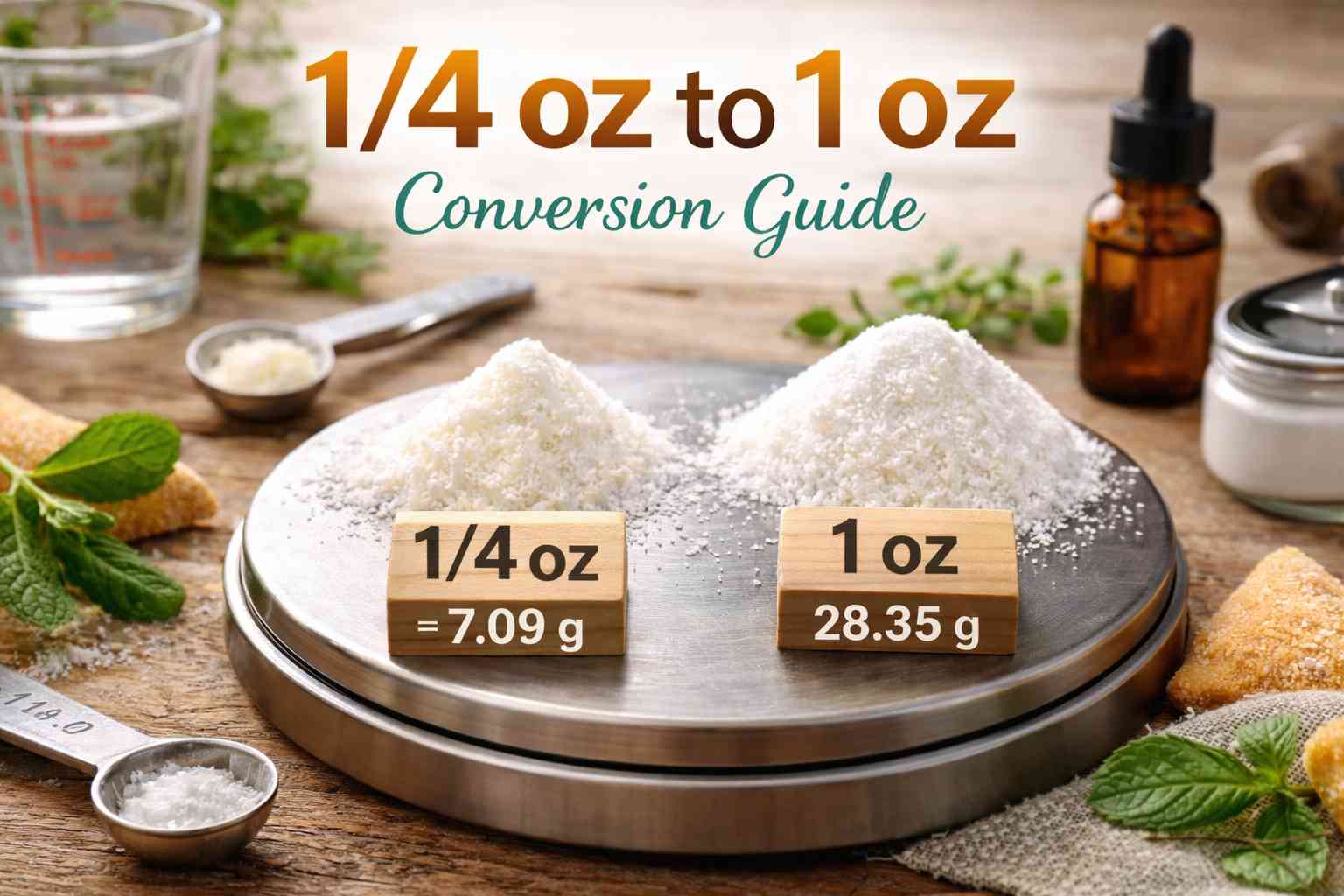
The conversion from 1/4 oz to 1 oz is a direct fractional relationship within the standard ounce measurement system. One ounce contains exactly four quarter-ounce units. This relationship stays constant across all applications that use the avoirdupois ounce, which is the globally accepted system for everyday weight measurement.
According to the International Yard and Pound Agreement, one avoirdupois ounce equals 28.3495 grams. This fixed definition allows accurate and repeatable conversions in cooking, packaging, manufacturing, science, and commerce.
What 1/4 oz Means in Practical Terms
A quarter ounce (1/4 oz) represents one-fourth of a full ounce. It is commonly used when precise, small quantities are required.
Key characteristics of 1/4 oz:
-
Equals 0.25 oz
-
Represents 25% of one ounce
-
Used for portioning, labeling, and formulation
-
Converts to 7.09 grams in weight
This measurement appears frequently in recipes, supplements, cosmetics, and small containers.
What 1 oz Represents as a Standard Unit
An ounce (1 oz) is a standard unit of mass in the U.S. customary and British imperial systems.
Core attributes of 1 oz:
-
Equals 28.35 grams
-
Contains 4 × 1/4 oz
-
Used as a reference unit for fractional measurements
-
Serves as a base for packaging and labeling standards
Because the ounce is standardized, its fractional values remain mathematically consistent.
Direct Relationship Between 1/4 oz and 1 oz
The relationship between 1/4 oz and 1 oz is purely mathematical.
| Measurement | Value |
|---|---|
| 1 oz | 4 × 1/4 oz |
| 1/4 oz | 1 ÷ 4 oz |
| Ratio | 1:4 |
This ratio does not change based on industry, material, or application when measuring weight.
Converting 1/4 oz to 1 oz in Grams (Weight)
Weight-based conversions use the avoirdupois ounce.
Official standard (NIST):
-
1 oz = 28.3495 g
Derived conversion:
-
1/4 oz = 28.3495 ÷ 4 = 7.087 g
Weight Conversion Table
| Ounces | Grams |
|---|---|
| 1/4 oz | 7.09 g |
| 1/2 oz | 14.17 g |
| 3/4 oz | 21.26 g |
| 1 oz | 28.35 g |
This table is used across laboratories, food production, and industrial measurement systems.
Understanding Fluid Ounces vs Weight Ounces
The term “ounce” has two distinct meanings.
Weight ounce (oz):
-
Measures mass
-
Expressed in grams
-
Used for solids and materials
Fluid ounce (fl oz):
-
Measures volume
-
Expressed in milliliters
-
Used for liquids
These two units are not interchangeable without additional information.
Converting 1/4 fl oz to 1 fl oz in Milliliters
According to U.S. customary volume standards:
-
1 fl oz = 29.57 mL
Fluid Conversion (U.S.)
| Fluid Ounces | Milliliters |
|---|---|
| 0.25 fl oz | 7.39 mL |
| 0.5 fl oz | 14.79 mL |
| 0.75 fl oz | 22.18 mL |
| 1 fl oz | 29.57 mL |
This conversion applies only to volume, not weight.
Why 1/4 oz and 1/4 fl oz Are Not the Same
Weight and volume measure different physical properties.
-
Weight depends on mass.
-
Volume depends on space occupied.
To convert between them, density is required.
Density formula:
-
Density = Mass ÷ Volume
Without density, a direct conversion between oz and fl oz is not scientifically valid.
Read Also: To Pour Water on Calcium Oxide: Complete Guide to the Reaction, Safety, and Uses
Density Example Using Water
Water provides a reference because its density is close to 1 g/mL.
Calculation:
-
1/4 oz = 7.09 g
-
7.09 g ÷ 1 g/mL = 7.09 mL
This equivalence applies only to water at standard conditions.
Liquids such as oil, honey, syrup, or alcohol produce different results.
Usage of 1/4 oz to 1 oz in Cooking
In cooking, ounces are often approximated for convenience.
Common culinary approximations (water-based):
-
1 oz ≈ 2 tablespoons
-
1/4 oz ≈ 1.5 teaspoons
These approximations are used in kitchens but are not suitable for professional food production or nutrition labeling.
Usage of 1/4 oz to 1 oz in Packaging
Packaging industries commonly label containers using fluid ounces.
Typical container volumes:
| Label | Approximate Volume |
|---|---|
| 1/4 oz bottle | ~7.4 mL |
| 1/2 oz bottle | ~15 mL |
| 1 oz bottle | ~30 mL |
Container labels indicate capacity, not filled weight. Headspace is included for sealing and safety.
Application in Manufacturing and Industry
Fractional ounces are widely used in manufacturing.
Industries using 1/4 oz increments:
-
Cosmetics
-
Pharmaceuticals
-
Fishing tackle
-
Nutritional supplements
-
Chemical formulation
Precision in fractional ounces ensures batch consistency and regulatory compliance.
Common Errors When Converting 1/4 oz to 1 oz
-
Mixing weight and volume units
-
Ignoring density
-
Using troy ounces instead of avoirdupois
-
Applying excessive rounding
-
Assuming all liquids weigh the same
Avoiding these errors maintains measurement accuracy.
Avoirdupois Ounce vs Troy Ounce
| Type | Grams |
|---|---|
| Avoirdupois oz | 28.35 g |
| Troy oz | 31.10 g |
Troy ounces are used only for precious metals. They are not used for general weight measurement.
Quick Reference Summary Table
| Measurement | Equivalent |
|---|---|
| 1 oz | 4 × 1/4 oz |
| 1/4 oz | 0.25 oz |
| 1 oz | 28.35 g |
| 1/4 oz | 7.09 g |
| 1 fl oz | 29.57 mL |
| 1/4 fl oz | 7.39 mL |
See More: Detailed Guide to HCOOCH CH₂ H₂O: Hydrolysis, Properties, and Applications
Frequently Asked Questions (FAQs)
How many 1/4 oz make 1 oz?
Four quarter-ounce units equal one ounce.
Is 1/4 oz equal to 7 grams?
Yes. 1/4 oz equals approximately 7.09 grams.
Is 1 oz always 30 mL?
No. One U.S. fluid ounce equals 29.57 mL. The 30 mL value is rounding.
Can 1/4 oz and 1/4 fl oz be used interchangeably?
No. One measures weight and the other measures volume.
Does the conversion change for different materials?
Weight-to-weight conversions remain constant. Weight-to-volume conversions change based on density.
Conclusion
The conversion from 1/4 oz to 1 oz is a fixed fractional relationship defined by international measurement standards. One ounce always contains four quarter-ounce units. When measuring weight, this equals 7.09 grams to 28.35 grams. When measuring volume, fluid ounces convert to milliliters using different constants. Understanding unit type, system definition, and density ensures correct application in cooking, packaging, science, and industry.
