
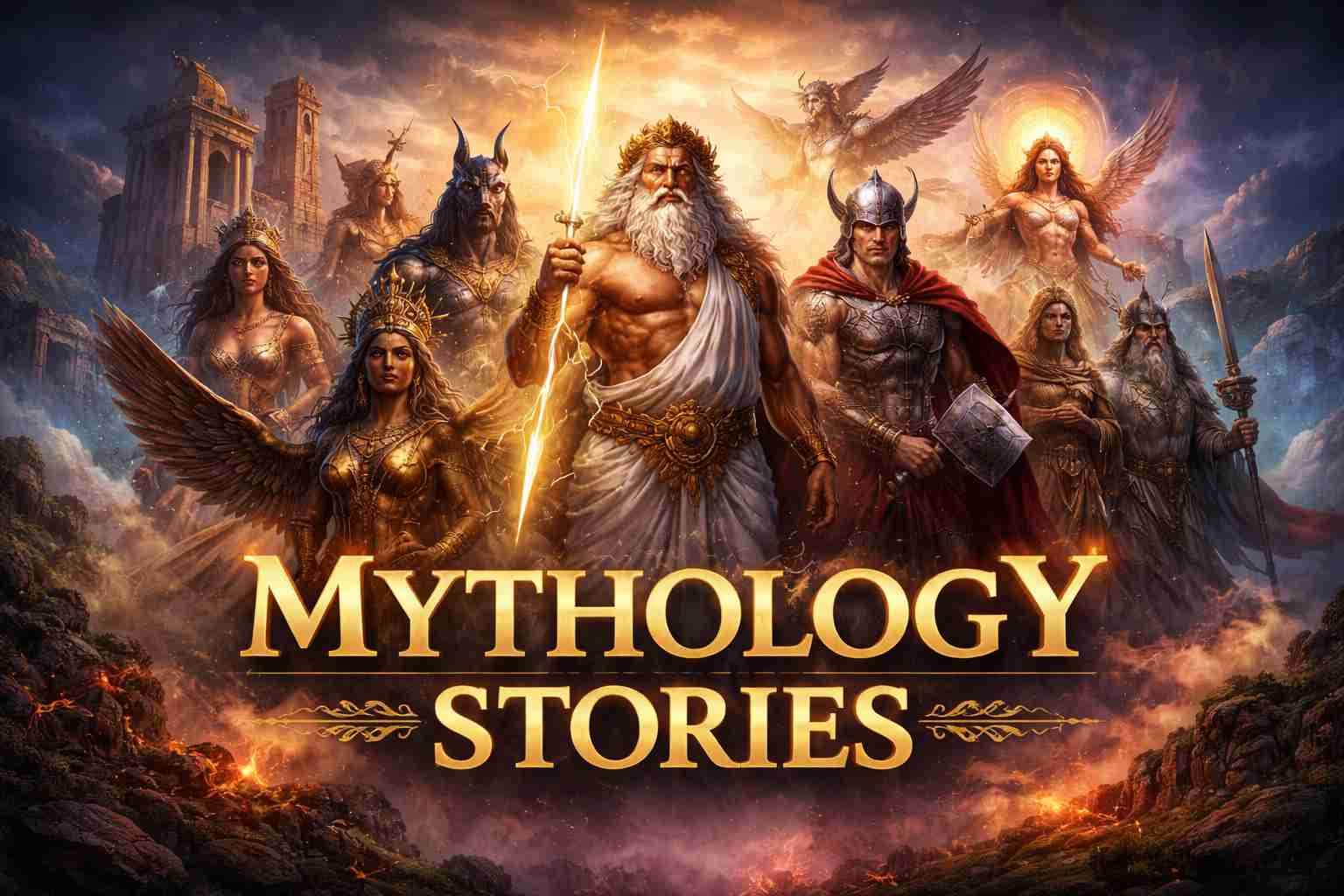
Mythology stories are traditional narratives that explain how the world began, how nature works, why societies follow rules, and how humans relate to gods and supernatural forces. Academic authorities such as Encyclopaedia Britannica describe mythology as a connected system of sacred stories passed through generations. These stories appear in every known culture. They form the foundation of religion, art, ethics, and social identity.
Mythology stories do not function as entertainment alone. They preserve cultural memory. They explain existence. They define moral order. They record early human understanding of life and death.
What Makes Mythology Stories Different From Other Stories
To understand mythology stories, distinguish them from related narrative forms.
Myths
Myths explain sacred truth. Gods, creation, and cosmic order form their core. These stories explain why the universe exists and how it functions.
Legends
Legends describe human or semi-human figures. These stories often connect to real locations or historical periods.
Folktales
Folktales focus on social lessons and entertainment. These stories do not carry sacred meaning.
Mythology stories always connect belief, ritual, and worldview. This feature separates them from other storytelling traditions.
Why Mythology Stories Exist in Every Culture
Mythology stories serve consistent purposes across civilizations.
Explain origins
Creation myths explain how the universe, earth, gods, and humans came into being.
Explain nature
Myths describe storms, seasons, earthquakes, floods, and celestial movement.
Explain morality
Mythology stories define right and wrong through divine reward and punishment.
Explain authority
Kingship, law, and social roles gain legitimacy through mythic approval.
Explain death
Underworld myths explain what happens after life ends.
These functions appear in nearly all myth systems worldwide.
See More: Byzantine Imagery in the Catholic Church: Origins, Meaning, and Influence
Main Types of Mythology Stories
Creation Myths
Creation myths describe the birth of the universe from chaos, water, darkness, or void.
Hero Myths
Hero myths focus on individuals facing monsters, trials, and divine challenges.
Transformation Myths
Transformation myths explain physical or spiritual change caused by gods.
Underworld Myths
Underworld myths describe death, judgment, and afterlife journeys.
Trickster Myths
Trickster myths show rule-breaking figures who create change through disruption.
Greek Mythology Stories
Greek mythology developed in ancient Greece and survives through epic poetry, theater, and art. Primary sources include the Iliad and Odyssey.
Key Greek mythology stories
-
Zeus rules the sky and enforces divine law.
-
Hades governs the underworld.
-
Persephone explains seasonal change.
-
Heracles completes twelve labors to achieve redemption.
-
Odysseus survives long trials through intelligence.
Greek mythology stories emphasize fate, pride, divine justice, and consequence.
Norse Mythology Stories
Norse mythology originates from early Scandinavian belief systems. These myths survive through the Poetic Edda and Prose Edda.
Key Norse mythology stories
-
Odin sacrifices knowledge for wisdom.
-
Thor protects gods and humans.
-
Loki creates chaos through deception.
-
Ragnarök ends the world through cosmic battle.
Norse mythology stories emphasize destiny, sacrifice, and heroic death.
Egyptian Mythology Stories
Egyptian mythology centers on balance, known as Ma’at, and eternal life.
Key Egyptian mythology stories
-
Ra creates life through the sun.
-
Osiris rules the afterlife after resurrection.
-
Isis restores life through magic.
-
Anubis judges souls after death.
Egyptian mythology stories focus on judgment, rebirth, and cosmic order.
Hindu Mythology Stories
Hindu mythology originates from ancient Indian texts such as the Ramayana and Mahabharata.
Key Hindu mythology stories
-
Vishnu preserves cosmic balance.
-
Shiva destroys and renews existence.
-
Rama represents duty and virtue.
-
Krishna guides moral action.
Hindu mythology stories emphasize duty, rebirth, and cosmic law.
Common Themes Across Mythology Stories
| Theme | Explanation |
|---|---|
| Creation | Explains the origin of existence |
| Fate | Defines unavoidable destiny |
| Sacrifice | Establishes cosmic balance |
| Transformation | Shows change through divine power |
| Justice | Enforces moral consequence |
How Mythology Stories Influence Modern Life
Shape literature
Classical myths influence novels, poetry, and drama.
Shape religion
Many modern beliefs trace back to ancient myths.
Shape art
Paintings, sculptures, and architecture reference mythology.
Shape psychology
Mythic archetypes influence academic psychology.
How to Start Reading Mythology Stories
Choose a culture
Greek and Norse myths suit beginners due to structure.
Choose a theme
Creation, heroes, or gods simplify selection.
Choose a format
Short retellings support early understanding.
Read Also: Lookout Position at the Top of the Mast: Full Guide to History, Purpose & Modern Use
Frequently Asked Questions About Mythology Stories
What are mythology stories?
Mythology stories are sacred narratives explaining gods, origins, and moral order.
Are mythology stories real?
These stories represent belief systems rather than historical records.
Which mythology stories are most famous?
Greek, Norse, Egyptian, and Hindu mythology stories hold global recognition.
Why do cultures share similar myths?
Human societies address similar questions about life and death.
Are mythology stories suitable for children?
Many myths require adapted versions due to mature themes.
Conclusion
Mythology stories record humanity’s earliest understanding of existence. These narratives define culture, belief, and moral structure. Greek, Norse, Egyptian, Hindu, and other traditions preserve unique perspectives while sharing universal themes. Mythology stories continue to influence education, religion, art, and global culture through their symbolic depth and historical significance.
