
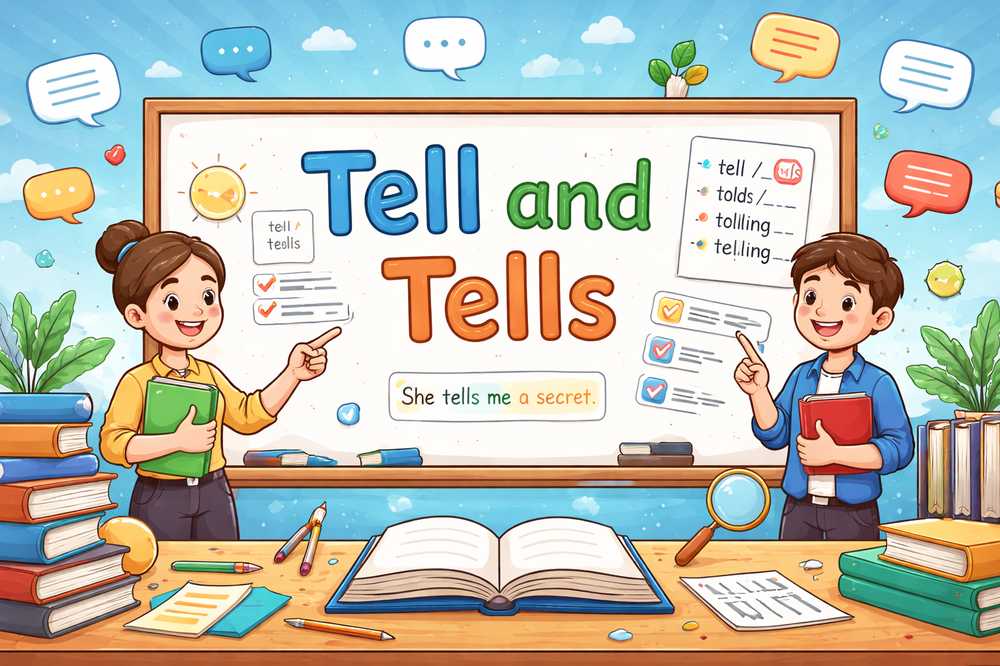
The keyword tell and tells relates to verb form, tense, and subject agreement in English grammar. The verb tell is used to pass information from one source to another. The verb tells marks present-tense agreement with a third-person singular subject. This explanation follows descriptions published by Cambridge University Press and Oxford University Press, which document modern English usage rules.
What Tell and Tells Mean
Definition of Tell
Tell is an irregular English verb.
Tell is used to communicate facts, instructions, decisions, or stories.
Tell usually requires a receiver of information.
Examples:
-
I tell the truth.
-
We tell our story.
Definition of Tells
Tells is the third-person singular present tense form of tell.
Tells is used only with singular subjects like he, she, it, or a singular noun.
Examples:
-
She tells the answer.
-
The report tells the result.
These forms are classified as standard verb agreement structures in English grammar references.
Difference Between Tell and Tells
Core Difference Explained Simply
The difference between tell and tells depends on the subject.
Tell is used with plural subjects or first- and second-person subjects.
Tells is used only with third-person singular subjects.
Comparison Table: Tell vs Tells
| Feature | Tell | Tells |
|---|---|---|
| Verb type | Base form | Present singular form |
| Subject type | I, you, we, they | He, she, it |
| Tense | Present | Present |
| Example | They tell the facts | He tells the facts |
This distinction follows subject-verb agreement rules taught in ESL education.
Verb Forms of Tell
Complete Conjugation of Tell
Tell follows an irregular verb pattern.
| Form Type | Verb Form |
|---|---|
| Base form | tell |
| Third-person singular | tells |
| Past tense | told |
| Past participle | told |
| Present participle | telling |
This structure is recorded in learner dictionaries and grammar databases maintained by major publishers.
When to Use Tell
Situations That Require Tell
Use tell when the subject is not third-person singular.
Use tell in commands and instructions.
Use tell when addressing someone directly.
Examples:
-
I tell the story clearly.
-
You tell the manager today.
-
Tell me the reason.
Tell fits present tense statements and imperatives.
Read Also: Meaning and Scope of ۰۰۲۲ Explained Clearly
When to Use Tells
Situations That Require Tells
Use tells only when the subject is third-person singular.
Use tells to describe facts, habits, or repeated actions.
Examples:
-
She tells the truth often.
-
The document tells the process.
Tells never appears with plural subjects.
Sentence Patterns Using Tell and Tells
Common Grammar Structures
Pattern 1: Tell + someone + something
-
Tell me the answer.
-
She tells him the rules.
Pattern 2: Tell + someone + that-clause
-
He tells us that the plan changed.
-
She tells me that the data is correct.
Pattern 3: Tell + someone + to + verb
-
Tell her to wait.
-
He tells them to leave early.
These patterns appear in formal and informal English writing.
Why Tell Needs an Object
Object Requirement Explained
Tell is a transitive verb.
Tell normally requires a receiver of information.
The receiver can be a noun or a pronoun.
Correct usage:
-
She told me the result.
Incorrect usage:
-
She told the result.
This rule is confirmed in grammar guides published by British Council.
Common Collocations With Tell and Tells
Frequently Used Word Combinations
Communication Collocations
-
Tell a story
-
Tell a joke
-
Tells a message
Truth and Accuracy
-
Tell the truth
-
Tell a lie
-
Tells the facts
Understanding and Judgment
-
Tell the difference
-
Something tells me that
-
Evidence tells the conclusion
These combinations appear frequently in written and spoken English.
Tell and Tells in Reported Speech
Reported Speech Rules
Tell is used in reported speech when a listener is mentioned.
Tells follows the same rule in present tense.
Examples:
-
She said, “I am ready.”
→ She told me that she was ready. -
He says, “The meeting starts now.”
→ He tells us that the meeting starts now.
This usage aligns with reported speech frameworks used in academic grammar.
Tell and Tells Compared With Say
Basic Grammar Difference
Tell focuses on the receiver of information.
Say focuses on the words spoken.
Comparison examples:
-
Say something.
-
Tell someone something.
Tell requires an object.
Say does not always require an object.
This distinction is documented in learner grammar references.
Common Mistakes With Tell and Tells
Frequent Errors to Avoid
-
Using tells with plural subjects.
-
Using tell without an object.
-
Confusing told and tells.
-
Replacing tell incorrectly with say.
Correct sentence structure improves clarity and grammar accuracy.
Use of Tell and Tells in Formal Writing
Academic and Professional Usage
Tell appears in instructional writing.
Tells appears in reports and explanations.
Examples:
-
The manual tells the steps clearly.
-
The data tells the trend accurately.
These forms appear in formal documents and educational texts.
Linguistic Classification of Tell
Grammar Category
Tell is classified as a reporting verb.
Tell belongs to the communication verb group.
Tell expresses transfer of knowledge or instructions.
This classification is supported by applied linguistics research.
Tell and Tells: Key Points Summary
Essential Grammar Facts
-
Tell is the base form.
-
Tells is the third-person singular form.
-
Tell usually needs an object.
-
Tells follows strict subject agreement rules.
-
Tell supports multiple sentence patterns.
These facts follow standard English grammar authorities.
See More: Understanding “59 Days From Today” Clearly and Accurately
Frequently Asked Questions About Tell and Tells
What is the main difference between tell and tells?
Tell is the base verb form.
Tells is used only with third-person singular subjects.
Is tells present tense?
Yes.
Tells is present tense and singular.
Can tell be used without an object?
Tell usually requires an object.
Exceptions occur only in limited informal contexts.
What is the past tense of tell?
The past tense of tell is told.
Is something tells me grammatically correct?
Yes.
The subject something is singular, so tells is correct.
Conclusion
The topic tell and tells focuses on subject–verb agreement and correct verb form usage in English grammar. Tell functions as the base verb form used with plural subjects and first- or second-person subjects. Tells functions as the third-person singular present tense form used with singular subjects such as he, she, it, or singular nouns. The verb tell is classified as a transitive reporting verb, which explains its regular need for a receiver of information. Accurate use of tell and tells improves sentence clarity, grammatical precision, and meaning accuracy in both spoken and written English. Mastery of these forms supports correct tense selection, proper sentence structure, and effective communication across formal, academic, and professional contexts.
