
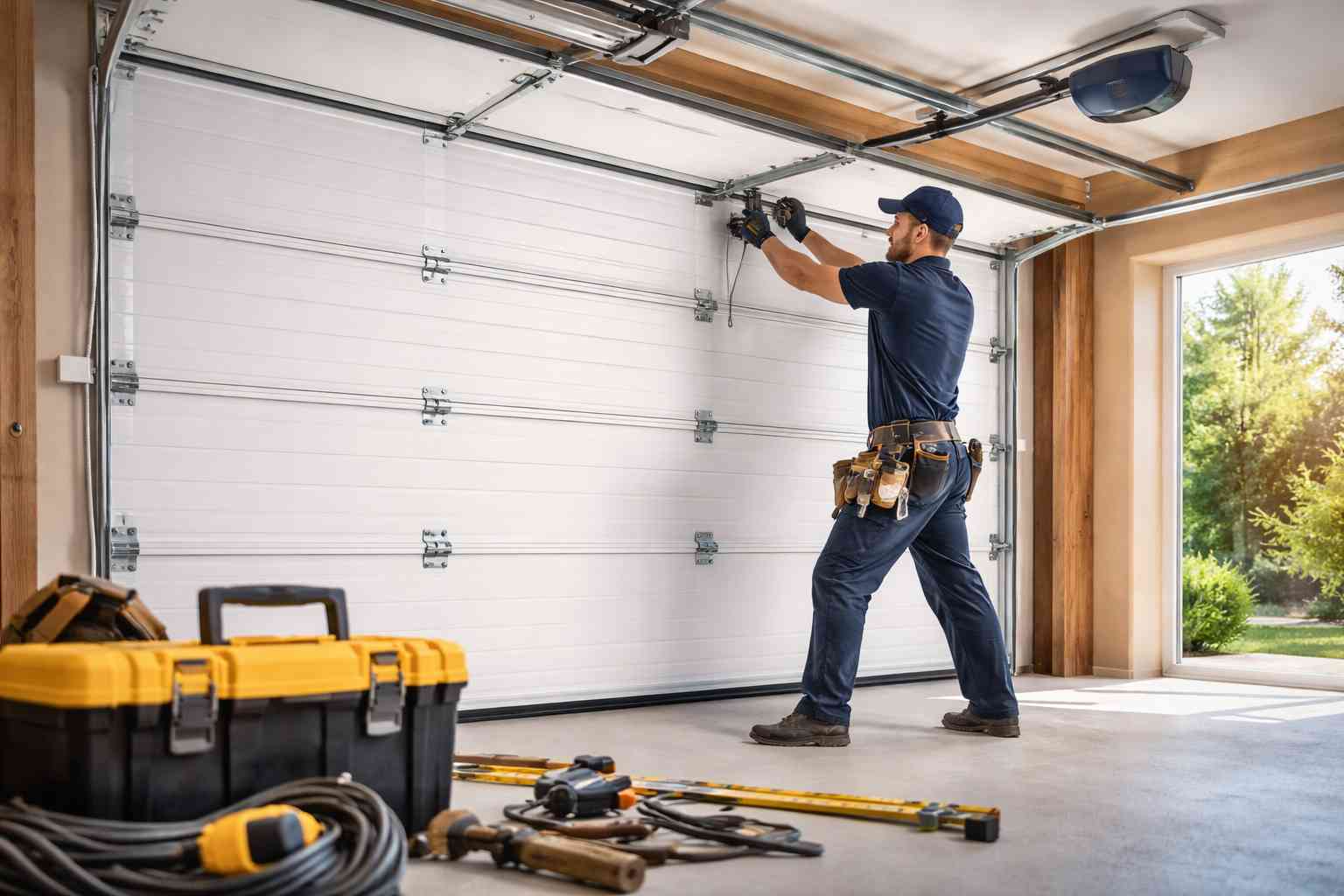
Garage door installation is the controlled process of fitting a door system into a garage opening. The system includes the door panels or curtain, track assemblies, counterbalance springs, lifting cables, rollers, brackets, safety devices, and optional motorized openers. Industry sources such as DASMA (Door & Access Systems Manufacturers Association), UL (Underwriters Laboratories), and CPSC (Consumer Product Safety Commission) define garage doors as powered or manual moving assemblies with mechanical load and safety risk. Correct installation improves access control, structural fit, thermal control, and operational safety.
What garage door installation includes
Garage door installation includes component fitting, mechanical balancing, alignment, and functional testing. A complete installation includes the following entities:
-
Door assembly (sectional panels, roller curtain, or tilt-up slab)
-
Track system (vertical tracks, horizontal tracks, hangers)
-
Counterbalance system (torsion springs or extension springs)
-
Load path components (cables, drums, bearings, shafts)
-
Safety devices (photoelectric sensors, auto-reverse settings)
-
Control systems (wall control, remote transmitters, smart controllers)
Each entity interacts with the door load. Torsion springs offset door weight. Tracks guide motion. Rollers reduce friction. Safety sensors protect users. These interactions define door performance and cycle life.
How to plan garage door installation
To plan garage door installation, define opening geometry, select door type, and verify site conditions. Manufacturer installation manuals and DASMA technical data provide the authority for planning.
Measure opening geometry
Measure clear width, clear height, headroom, sideroom, and backroom. Sectional doors require headroom for torsion spring mounting. Low-headroom kits reduce required headroom. Backroom defines horizontal track length. Sideroom defines track and spring clearance.
Select door type
Sectional doors suit most residential garages. Roller doors suit low-backroom spaces. Tilt-up doors suit open interiors with swing clearance. Side-hinged doors suit non-powered use cases. Door type determines hardware layout and safety profile.
Select door construction
Steel doors provide corrosion resistance. Insulated sandwich panels improve thermal performance. Polyurethane foam cores provide higher R-values than polystyrene cores. Reinforced stiles increase wind resistance. Glazed sections add daylight but reduce insulation value.
Verify structure and substrate
Wood framing accepts lag screws. Concrete block walls require masonry anchors. Header alignment affects track plumb. Uneven substrates increase roller wear and noise.
Confirm electrical provision
UL-listed openers require grounded outlets. Dedicated circuits stabilize opener load. Battery backup modules maintain function during power loss.
How to prepare the site before installation
To prepare the site before installation, clear obstructions, stabilize framing, and stage components. OSHA worksite safety guidance supports controlled preparation.
Remove old assemblies
Detach old panels, tracks, and springs using controlled unloading. Torsion springs store rotational energy. Sudden release causes injury. Controlled unwinding procedures reduce risk.
Inspect framing condition
Inspect jambs and header for rot, cracks, or bowing. Reinforce weak framing with steel angles or treated lumber. Structural integrity supports track anchoring loads.
Level the floor line
Check floor slope at the opening. Bottom seals rely on level contact. Uneven floors create air gaps and water intrusion.
Stage components by sequence
Place panels, tracks, and hardware in installation order. Sequenced staging reduces assembly errors and rework.
Read Also: Masculine Bath: Meaning, Design Principles, and Complete Setup Guide
How to install a sectional garage door (technical sequence)
To install a sectional garage door, assemble panels, mount tracks, and set the counterbalance system. Manufacturer manuals define torque values and fastener spacing.
Install bottom panel
Place the bottom panel at the opening. Attach bottom brackets with reinforced fasteners. Fit weather seal along the bottom edge to control air and water entry.
Attach rollers and hinges
Insert rollers into hinge sleeves. Secure hinges at panel joints. Hinge gauge increases toward the top section to control track geometry.
Stack and align panels
Position the next panel. Engage hinges. Maintain horizontal alignment using a level. Panel alignment controls seal compression and track clearance.
Mount vertical tracks
Anchor vertical tracks to jamb brackets. Maintain plumb alignment. Track plumb controls roller contact and door travel smoothness.
Mount horizontal tracks and hanger
Suspend horizontal tracks from ceiling joists using angle iron. Maintain parallel spacing. Track parallelism prevents side loading on rollers.
Install torsion shaft and springs
Mount center bearing plate. Insert torsion shaft. Fix cable drums at shaft ends. Wind springs according to door height and drum circumference. DASMA winding tables define turns per door height. Proper winding balances door weight.
Route cables and set tension
Attach lifting cables to bottom brackets. Route cables to drums. Apply equal tension on both sides. Unequal tension skews door travel.
Perform balance test
Lift door manually. Balanced doors remain stationary at mid-height. Balance accuracy reduces opener load and spring fatigue.
How to install a roller garage door (compact layout)
To install a roller garage door, mount barrel brackets, fit curtain, and set spring pre-tension. Roller systems reduce ceiling track hardware.
Position barrel brackets
Mark bracket locations based on opening width and headroom. Bracket alignment controls curtain roll path.
Mount axle and curtain
Fix axle assembly to brackets. Feed curtain slats into guide rails. Lock bottom rail stops to prevent over-travel.
Apply spring pre-tension
Set pre-tension using manufacturer torque values. Pre-tension offsets curtain mass.
Verify smooth travel
Cycle door through full travel. Adjust guide alignment for low friction.
How to install a garage door opener
To install a garage door opener, mount the motor unit, align the rail, and configure safety devices. UL 325 safety standards define opener safety requirements.
Mount motor unit
Fix motor housing to ceiling joists with vibration-isolating brackets. Rigid mounting improves rail alignment.
Align rail and header bracket
Attach rail to header bracket above the door centerline. Straight alignment reduces chain or belt wear.
Attach door arm to top section
Use reinforced mounting plates. Door arm transfers pulling force to the door structure.
Install photoelectric safety sensors
Mount sensors near floor level on each side. Align infrared beam across opening. Sensor obstruction triggers auto-reverse.
Program travel limits and force settings
Set open and close limits. Set force sensitivity to meet safety thresholds. Proper calibration reduces crush risk.
Post-installation inspection and testing
Post-installation inspection confirms alignment, balance, and safety function. DASMA commissioning checklists guide testing.
-
Verify door balance at mid-height
-
Verify track parallelism and plumb
-
Verify safety sensor alignment and reversal function
-
Verify seal compression and weather resistance
-
Verify noise and vibration levels
Cost structure for garage door installation
Garage door installation cost consists of door cost, labor cost, and accessory cost. Aggregated contractor data from Angi and HomeAdvisor describe typical cost drivers.
| Cost Component | Cost Drivers | Impact on Total |
|---|---|---|
| Door assembly | Material, insulation, size, glazing | High |
| Labor | Framing condition, door weight | Medium |
| Opener system | Drive type, smart features | Medium |
| Removal and disposal | Old door size, haul-away | Low |
| Reinforcement kits | Wind load rating, bracing | Medium |
Lifecycle cost relates to spring cycle rating, roller bearing quality, and insulation value. Higher cycle springs reduce replacement frequency.
Maintenance after installation
Maintenance preserves safety and performance. Manufacturer service manuals define maintenance intervals.
-
Apply lubricant to rollers, hinges, and bearings
-
Inspect fasteners and track anchors
-
Monitor cable wear and drum alignment
-
Clean photoelectric sensors
-
Test auto-reverse monthly
Preventive maintenance reduces friction, noise, and premature component failure.
Common installation errors and corrections
Common installation errors involve misalignment, imbalance, and sensor faults.
| Error Type | Technical Cause | Correction Method |
|---|---|---|
| Door binds in track | Track misalignment | Adjust bracket spacing |
| Door closes unevenly | Unequal cable tension | Reset drum tension |
| Opener reverses early | Sensor misalignment | Realign sensor brackets |
| Excessive noise | Worn steel rollers | Replace with nylon bearings |
| Door drops when open | Under-wound torsion springs | Apply correct winding turns |
Safety considerations and compliance
Garage door systems involve stored energy and moving loads. CPSC injury data links spring handling and door falls to user harm. UL 325 defines opener safety performance. Local building codes define wind load and anchorage requirements. ASTM E330 pressure testing supports wind-rated door certification. Compliance ensures safe operation and code acceptance.
Best practices for long-term performance
Long-term performance depends on correct installation, balanced load, and routine inspection. Reinforced end stiles improve wind resistance. Insulated panels stabilize interior temperature. Nylon rollers reduce vibration. Proper balance extends opener motor life. Documented maintenance preserves warranty validity.
Frequently Asked Questions (FAQs)
What defines a balanced garage door?
A balanced garage door remains stationary at mid-travel due to matched spring torque and door mass.
What controls garage door wind resistance?
Wind resistance depends on panel reinforcement, track anchoring, and tested pressure ratings.
What increases garage door noise?
Noise increases due to steel rollers, misaligned tracks, and dry bearings.
What improves garage door insulation performance?
Insulation performance improves with polyurethane cores, continuous perimeter seals, and thermal breaks.
What determines garage door cycle life?
Cycle life depends on spring rating, roller bearing quality, and alignment accuracy.
What reduces opener strain?
Reduced opener strain results from accurate door balance and low-friction rollers.
What limits opener safety risk?
Safety risk decreases with aligned photoelectric sensors and calibrated auto-reverse force.
Conclusion
Garage door installation integrates mechanical assembly, structural anchoring, balance calibration, and safety system configuration. Standards from DASMA, UL, ASTM, and CPSC define safe practices and performance requirements. Accurate measurement, aligned tracks, balanced springs, and verified safety devices produce reliable operation, improved security, and long service life.
