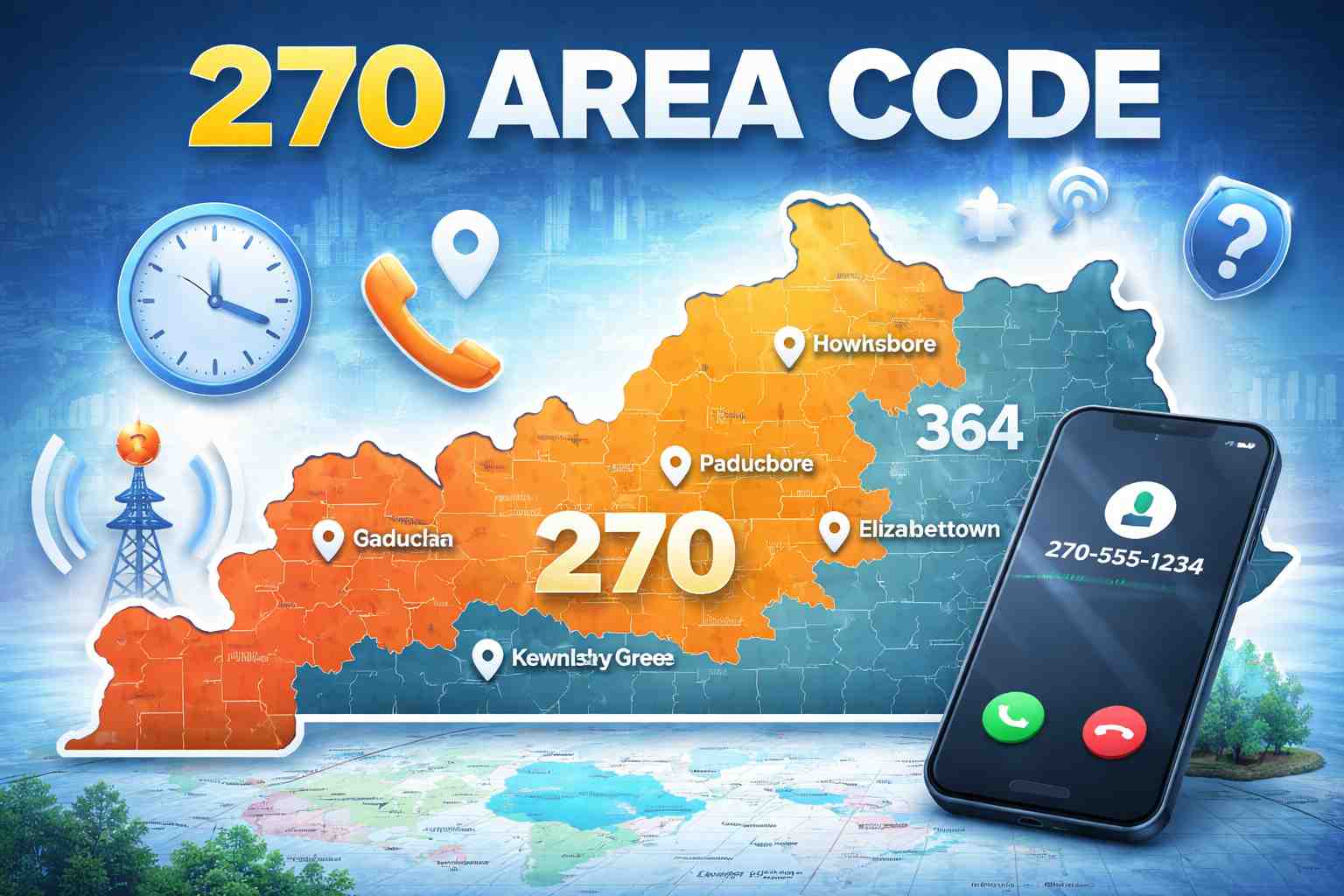
The 270 area code identifies a defined telephone numbering region within the North American Numbering Plan. The code serves a large portion of western and south-central Kentucky. Numbering authority and long-term planning originate from North American Numbering Plan Administration, with state-level coordination handled by the Kentucky Public Service Commission. The area code functions as a routing identifier. It directs calls to switching centers located inside its assigned geographic footprint. The code operates alongside an overlay rather than being geographically exclusive.
Geographic footprint and regional identity
The 270 area code spans diverse terrain across Kentucky. The region includes river-based trade corridors, agricultural zones, and manufacturing hubs.
Primary cities within the 270 area code
The largest population and economic centers include:
-
Bowling Green
-
Owensboro
-
Hopkinsville
-
Paducah
-
Henderson
These cities anchor surrounding rural exchanges and define local calling patterns.
County-level coverage characteristics
The area code extends across more than forty counties. Coverage includes river counties along the Ohio River and inland counties tied to interstate highway systems. This combination produces mixed residential, industrial, and logistics traffic within the numbering region.
Time zone structure inside the 270 area code
The 270 area code operates across two U.S. time zones.
Time zone allocation
| Time Zone |
General Coverage Area |
UTC Offset (Standard) |
| Central Time |
Western and far-southern counties |
UTC-6 |
| Eastern Time |
Eastern boundary counties |
UTC-5 |
Relationship between 270 and the 364 overlay
Definition of an overlay
An overlay introduces an additional area code to the same geographic region. The purpose is to expand numbering capacity without altering existing boundaries.
270 and 364 interaction
| Attribute |
Description |
| Original code |
270 |
| Overlay code |
364 |
| Overlay activation |
2014 |
| Dialing format |
Mandatory 10-digit dialing |
| Number reassignment |
None for existing subscribers |
Historical development of the 270 area code
Creation timeline
-
1999: The 270 area code formed through a split from the original 502 area code.
-
Early 2000s: Growth in mobile devices increased number utilization.
-
2014: The 364 overlay entered service following NANPA exhaustion forecasts.
Structural significance
The transition reflects national trends. Mobile adoption and competitive local exchange carriers increased numbering demand across the region
Dialing rules and call routing logic
Dialing format requirements
All calls within the 270 area code follow a ten-digit dialing structure:
This rule applies to:
-
Local calls
-
Long-distance calls
-
Landline connections
-
Mobile networks
Routing consistency supports modern switching systems and VoIP interconnection
See More: Understanding Tell and Tells in English Grammar
Economic and institutional usage patterns
Dominant industry sectors
The 270 region supports multiple industries:
-
Manufacturing and automotive supply chains
-
Agriculture and food processing
-
Healthcare systems
-
Higher education institutions
-
Transportation and warehousing
Institutional presence
Educational and medical organizations operate extensive numbering blocks, including institutions such as Western Kentucky University. These blocks generate stable, long-term number utilization.
Number portability and geographic interpretation
Portability explanation
Number portability allows subscribers to retain their phone numbers when changing carriers or locations. As a result, a 270 number does not guarantee current physical presence within Kentucky.
Practical implication
Caller location inference based solely on area code lacks accuracy. Regulatory guidance from the Federal Communications Commission confirms this limitation
Call legitimacy and fraud indicators
Legitimate call sources
Calls from the 270 area code commonly originate from:
Fraud association reality
Scam operations often display local numbers through spoofing. The Federal Trade Commission identifies spoofing as a common tactic across all U.S. area codes.
Spam call mitigation methods
Verification and prevention actions
-
Verify number using official business directories.
-
Enable filtering through smartphone operating systems.
-
Activate carrier tools for network-level detection.
-
Report abuse through federal reporting channels.
Regulatory support
The National Do Not Call Registry provides additional enforcement mechanisms against unauthorized telemarketing.
Comparative context within Kentucky
Kentucky area code distribution
| Area Code |
Primary Region |
| 270 |
Western and south-central Kentucky |
| 364 |
Overlay for 270 |
| 502 |
Louisville metropolitan area |
| 606 |
Eastern Kentucky |
| 859 |
Northern Kentucky and Lexington |
Technical attributes of the 270 area code
Numbering characteristics
These attributes align with nationwide telecommunications standards.
Read Also: Understanding the Question: How Many Oz in a Gallon
FAQs about the 270 area code
Does the 270 area code indicate rural or urban status?
The code covers both rural counties and mid-sized cities. Urban density concentrates around Bowling Green and Owensboro.
Is the 270 area code reserved for landlines?
The code supports landline, mobile, and VoIP services without restriction.
Does the 364 overlay change existing phone numbers?
Existing numbers remain unchanged. The overlay only affects new number assignments.
Can a business outside Kentucky use a 270 number?
Yes. Number portability and VoIP provisioning allow non-local usage.
Does the area code determine call cost?
Area codes do not define billing. Call cost depends on carrier plans and service agreements.
Conclusion
The 270 area code represents a mature and stable numbering region within Kentucky. Its overlay structure, dual time zone operation, and broad economic integration illustrate modern telecommunications planning. The code functions as a geographic identifier, not a guarantee of caller location, and remains essential to regional connectivity across western and south-central Kentucky.